

A lower case price should mean a better deal. In foodservice, it doesn’t always work that way. Freight, delivery fees, and purchasing allowances can change what you actually pay to get a product into your operation. The supplier with the lowest quote may not have the lowest delivered cost.
That’s why invoice price and landed cost deserve separate attention. One tells you what’s being charged for the product. The other puts that price in the context of getting it to a defined destination. For purchasing teams balancing tight margins, multiple distributors, and changing order patterns, that distinction matters.
What Is Invoice Price?
Invoice price is the amount a supplier bills for a product, usually shown as a unit or case price. If an invoice lists 100 cases of chicken at $40 per case, the product charge is $4,000.
There’s a wrinkle: an invoice can also include freight, fuel surcharges, taxes, or credits. For this comparison, invoice price means the product line-item price, not necessarily the total at the bottom of the invoice. Always check what a quoted price includes before comparing it with another offer.
What Is Landed Cost?
Landed cost is the total cost of acquiring a product and getting it to a defined receiving point, such as a distribution center or restaurant. It generally combines the purchase price with applicable freight, handling, duties, nonrecoverable taxes, and other acquisition charges, less eligible discounts and allowances.
The receiving point matters. A cost measured at a distributor’s warehouse is not directly comparable with a cost measured at your restaurant’s back door. Set that boundary first, then apply it consistently.
Landed Cost vs. Invoice Price: What Is the Difference?
Invoice price focuses on the product charge. Landed cost adds the costs required to acquire and deliver that product to your chosen destination, then accounts for applicable reductions.
Say one supplier quotes $40 per case and another quotes $41. The first looks cheaper until you learn that delivery costs extra. If the second supplier includes delivery, the higher case price could still produce a lower landed cost.
Neither number replaces the other. Invoice price helps you check product pricing against an agreement. Landed cost helps you compare the broader acquisition economics. You need both to understand whether a purchase makes sense.
What Costs Are Included in Landed Cost?
The components depend on your purchasing terms, delivery arrangement, and destination. The goal is consistent treatment—not adding every business expense to a case of product.
Freight and Delivery Charges
Include transportation costs required to move the product to the receiving point you’ve defined. Depending on the transaction, that could mean inbound freight, refrigerated transport, last-mile delivery, or a separately billed delivery charge.
First, check whether freight is already built into the case price. Adding it again would overstate landed cost. If a shipment contains several products, use a reasonable allocation method, such as weight, cube, or pallet space, rather than assigning every item the same freight amount by default.
Handling Fees and Surcharges
Receiving-related handling, unloading charges, fuel surcharges, and other acquisition-related fees may belong in landed cost. The right treatment depends on what the charge covers and where it occurs.
A lumping fee needed to unload a delivery at your defined receiving point may qualify. An ongoing fee for storing inventory after receipt is a different expense. Look at the activity behind the fee, not just its label.
Duties, Taxes, and Other Acquisition Costs
For imported products, customs duties, brokerage fees, and other costs required to bring goods to the destination may apply. Nonrecoverable purchase taxes may also be included. Recoverable taxes generally should not increase the product’s landed cost.
These charges won’t apply to every purchase. Use your actual transaction terms and accounting policies rather than adding a standard percentage across all products.
Discounts, Rebates, and Allowances
Eligible purchase discounts, rebates, and allowances can reduce acquisition cost, but only when they apply to the product and period you’re evaluating. A credit already reflected in the invoice price should not be deducted a second time.
Keep earned amounts separate from conditional incentives. A volume rebate that depends on hitting a year-end target is not the same as an unconditional invoice discount. For planning, you can model the expected rebate separately; for recorded inventory cost, follow your accounting team’s recognition policy.
What Is Not Typically Included in Landed Cost?
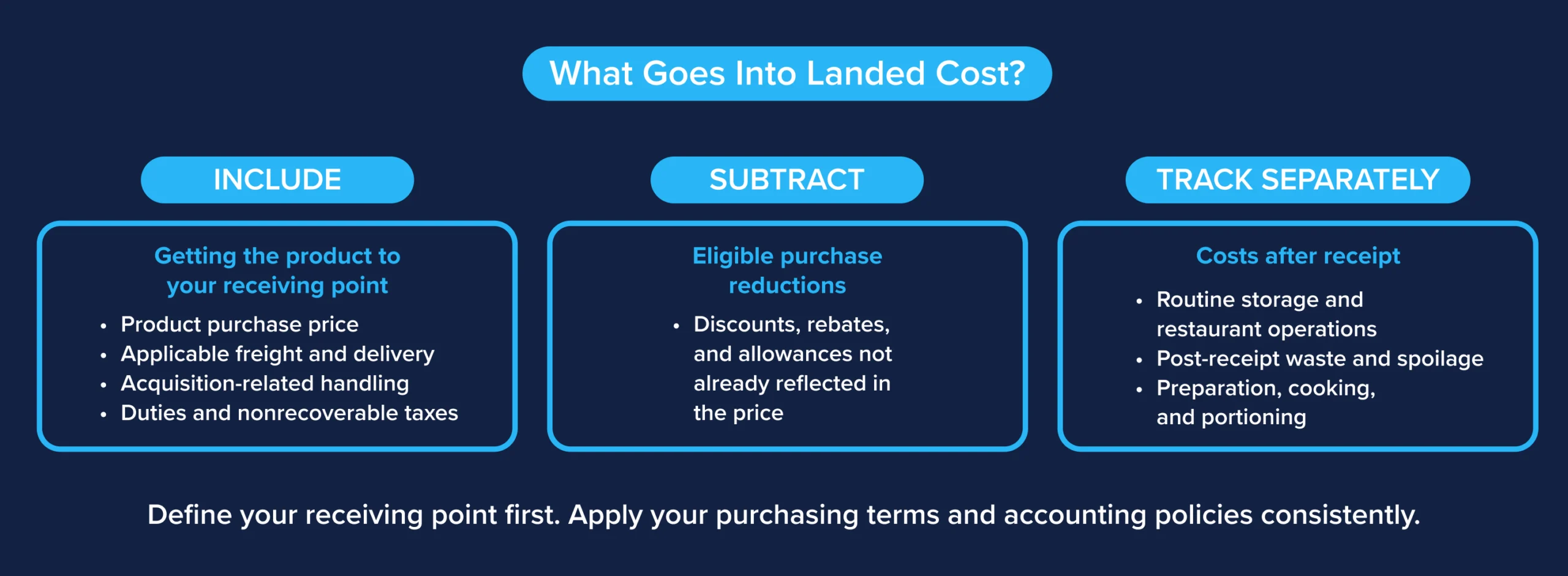
Landed cost is not the same as the total cost of running a restaurant or serving a menu item. Keeping that distinction clear makes purchasing comparisons more useful.
Restaurant-Level Labor and Operating Costs
Kitchen wages, front-of-house labor, rent, and routine utilities are generally operating expenses, not product acquisition costs. They matter to profitability, but they do not usually belong in the landed cost of a delivered case.
Labor specifically required for receiving or handling a shipment may need separate consideration. Your cost boundary and accounting policy should guide that decision.
Waste and Spoilage
Waste and spoilage after receipt generally are not added to landed cost. They affect how much usable product you get from the purchase and, ultimately, what each serving costs.
For example, a low-cost produce case may become expensive if a large share spoils before use. Track that loss alongside landed cost rather than folding it into the acquisition figure. Product damaged in transit is a separate receiving and claims issue that may require a credit or other adjustment.
Preparation and Production Costs
Trimming, cooking, portioning, and assembling menu items usually happen after the product has reached its destination. Those activities belong in recipe, production, or menu-cost analysis rather than landed cost.
This is especially important when comparing raw and prepared products. The raw option may have a lower landed cost but require more labor and produce less usable yield.
A Simple Example of Invoice Price vs. Landed Cost
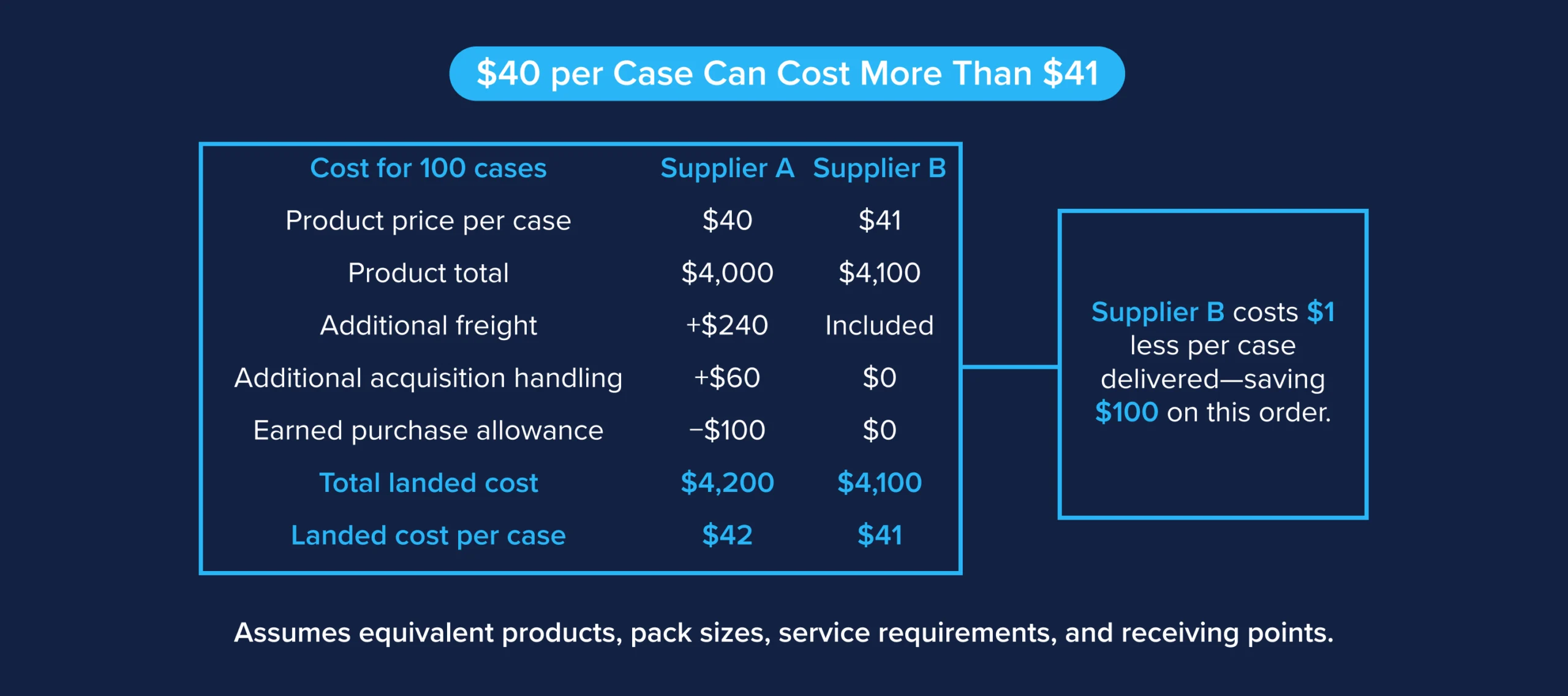
Suppose you order 100 cases of chicken for delivery to one restaurant. The invoice product price is $40 per case. Freight and acquisition-related fees are billed separately, and an earned allowance applies to this purchase.
Cost component|Amount
| Cost component | Amount |
| Product purchase: 100 cases × $40 | $4,000 |
| Freight | $240 |
| Acquisition-related handling | $60 |
| Earned purchase allowance | −$100 |
| Total landed cost | $4,200 |
| Landed cost per case | $42.00 |
The calculation is straightforward: ($4,000 + $240 + $60 − $100) ÷ 100 = $42 per case.
Now suppose another supplier offers an equivalent case for $41, with delivery included and no additional acquisition charges or allowances. That offer is $1 cheaper per case on a landed basis, even though its invoice product price is higher. Across this order, the difference is $100. This example assumes matching specifications, pack sizes, service requirements, and receiving points.
Why Invoice Price Alone Can Mislead Foodservice Buyers
A case price is easy to compare. The terms around it take more work. Delivery minimums, fuel charges, split-case fees, and rebate conditions can change the outcome without changing the quoted product price.
Pack differences can be just as misleading. A $35 case is not necessarily cheaper than a $38 case if it contains fewer pounds. And a price that works for a full truckload may not work for smaller, more frequent deliveries.
Invoice price also won’t tell you whether a lower-cost product creates more waste or slows down preparation. Start with landed cost for the acquisition comparison, then evaluate quality, yield, service, and operational fit separately.
How to Calculate Landed Cost in Foodservice
Use the same destination, units, and time period across the calculation. A repeatable method is more useful than a detailed model that every buyer applies differently.
Determine the Purchase Price
Start with the product charge for the quantity purchased. Confirm the item specification, pack size, unit of measure, and relevant contract terms.
If the invoice price already reflects a discount, use that net price. If freight is embedded, document that too so it isn’t added again later.
Add Freight and Other Acquisition Costs
Add the applicable transportation, handling, duties, nonrecoverable taxes, and other costs required to bring the product to the defined receiving point.
Allocate shared charges consistently. Weight may work well for some loads; pallet positions or cube may make more sense for others. Choose a method that reflects how the cost is incurred, and document it.
Account for Applicable Discounts and Allowances
Subtract eligible reductions that have not already been included in the product price. Match each reduction to the right products, quantities, and period.
If a rebate remains conditional, keep the base calculation and rebate scenario distinct. That gives buyers a clearer view of the cost they can rely on today versus the savings they may earn later.
Calculate the Cost Per Unit or Case
Landed cost = purchase price + applicable acquisition costs − eligible discounts and allowances.
Landed cost per case = total landed cost ÷ number of cases acquired.
For unlike pack sizes, convert the result to a comparable unit, such as dollars per pound, gallon, or each. Use the same basis for both suppliers. A per-case comparison only works when the cases are equivalent.
How Landed Cost Supports Better Purchasing Decisions
Once the components are visible, buyers can move beyond “Who has the lowest price?” to “Which option works best for this purchase?”
Compare Suppliers More Accurately
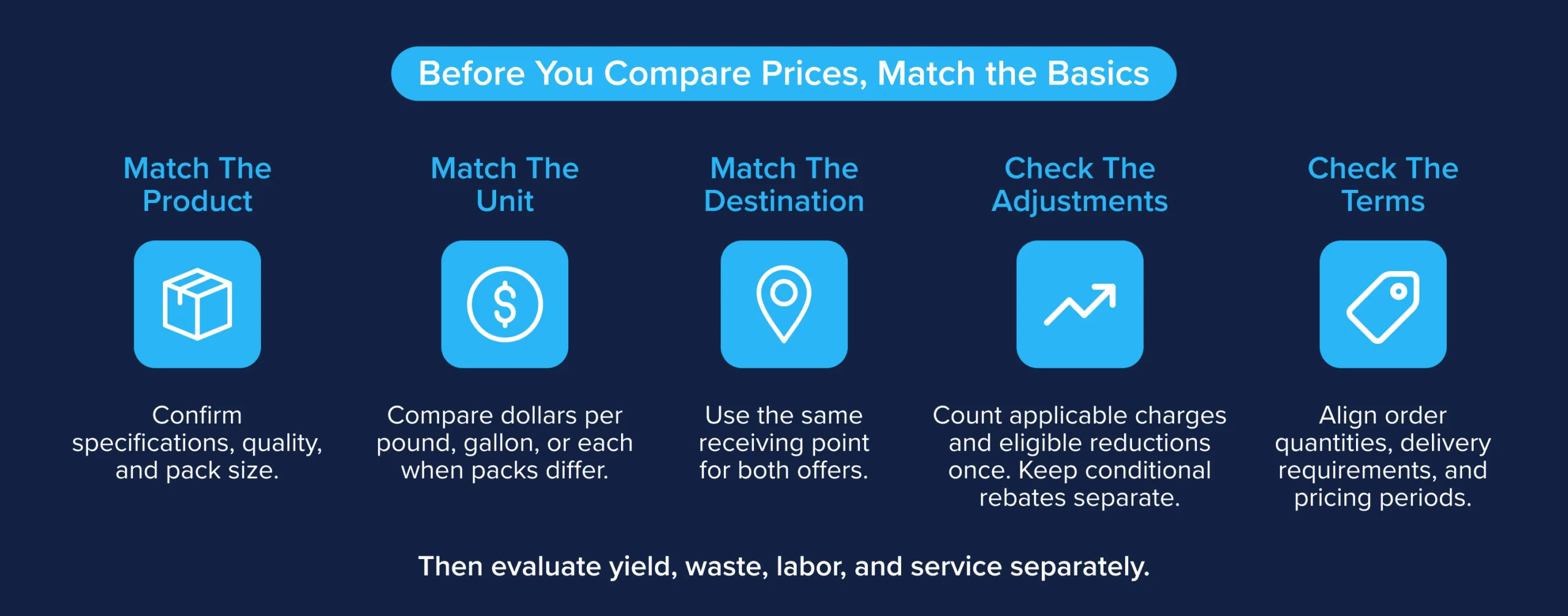
Compare equivalent products delivered to the same destination under comparable terms. Include the relevant fees and eligible reductions for each offer.
This gives suppliers a fairer comparison and gives your team a clearer explanation for its choice. A higher invoice price is easier to defend when the delivered economics are better.
Evaluate Purchasing Options
Landed cost can help you assess order sizes, delivery frequency, direct purchasing, and distributor-supported options. A larger order may reduce freight per case, but that does not automatically make it the better buy.
Check storage capacity, shelf life, inventory carrying costs, and cash requirements separately. Saving on delivery is not much of a win if the extra inventory expires before the kitchen can use it.
Identify Cost Drivers
Breaking out the components shows what is changing. Is the product price rising, or are freight and surcharges responsible for the increase? Are smaller orders increasing delivery cost per case?
Those answers point to different actions. A product-price issue may call for a contract discussion. A freight issue may call for a different delivery schedule or order pattern.
Improve Cost Visibility
A consistent landed-cost method gives purchasing, finance, and operations a shared basis for discussion. Instead of debating which number is right, teams can see the product price, the acquisition charges, and the adjustments behind the total.
Across locations, that can help surface inconsistent fees or purchasing patterns. It also makes it easier to explain why two restaurants buying the same item may have different delivered costs.
How Technology Improves Foodservice Cost and Pricing Visibility
The math is rarely the hardest part. Getting the right inputs together is. Product prices may sit in invoices, freight charges in separate bills, and allowance terms in agreements that someone has to track down.
Technology can help connect purchasing records, product information, and pricing terms so teams spend less time reconciling spreadsheets. Standardized item and unit data can also make comparisons more meaningful across suppliers and locations.
ArrowStream’s focus on foodservice supply chain visibility supports that broader goal: helping teams understand purchasing activity and pricing information so they can make more informed decisions. For landed-cost analysis, the practical questions remain important: Which charges are captured? Which allowances are confirmed? Are equivalent items being compared?
No platform can make an incomplete cost definition complete on its own. Clear rules, reliable data, and consistent review are what turn greater visibility into useful purchasing decisions.
Final Thoughts
Invoice price is a starting point, not the whole purchasing picture. Landed cost shows what it takes to acquire a product and get it to the destination that matters to your business.
Define that destination, use consistent cost categories, and compare equivalent units. Then look beyond acquisition cost to yield, waste, labor, and service. That’s how a lower number on a quote becomes a better decision for the operation.
FAQ’s
What Is the Difference Between Landed Cost and Invoice Price?
Invoice price is the product charge billed by the supplier. Landed cost includes that charge plus applicable costs to acquire and deliver the product to a defined receiving point, less eligible discounts and allowances. Some invoices include additional charges, so distinguish the product price from the invoice total.
What Costs Are Included in Landed Cost?
Typical components include the purchase price, freight, acquisition-related handling, duties, nonrecoverable taxes, and other necessary acquisition charges. Eligible discounts and allowances reduce the total. The exact components depend on the transaction and your defined receiving point.
How Do You Calculate Landed Cost in Foodservice?
Add the purchase price and applicable acquisition costs, then subtract eligible discounts and allowances. Divide the result by the number of cases or units acquired. Avoid counting embedded freight or already-applied discounts twice, and normalize pack sizes before comparing offers.
Why Is Landed Cost Important for Foodservice Operators?
It gives operators a more complete view of acquisition cost than product price alone. That helps buyers evaluate offers, understand delivery-related expenses, and see which charges are driving changes. It should still be considered alongside quality, yield, shelf life, and service.
Can Landed Cost Help Compare Suppliers?
Yes. It helps put offers on a comparable delivered-cost basis, provided you use equivalent products, units, receiving points, and terms. A supplier with a higher case price may have a lower landed cost if delivery is included or other acquisition charges are lower.
What Is the Difference Between Landed Cost and Effective Food Cost?
Landed cost measures acquisition cost through a defined receiving point. Effective food cost is used less consistently, but it generally looks at the cost of food actually usable or consumed, accounting for factors such as yield, waste, spoilage, and portioning.
A product can have a lower landed cost yet cost more per usable serving. Define what your organization means by effective food cost before using it in reports or supplier comparisons.