FSMA 204 Deadline Extended to July 20, 2028
The latest updates to FSMA 204 and what ArrowStream is doing to ensure you are compliant by July 20, 2028.
Countdown to July 20, 2028 Compliance Deadline
Does FSMA 204 Apply to my Restaurant?
If your restaurant handles foods on the Food Traceability List (FTL), you may be subject to FSMA 204 recordkeeping requirements. Understanding your responsibilities now can help simplify compliance ahead of the July 20, 2028 deadline.
*$250,000 or less in average annual food sales: Fully exempt from the rule (3-year rolling average, adjusted for inflation from 2020. (§1.1305(i)).
*$250,000 to $1 million: In October 2026, the FDA issued draft guidance saying it does not intend to enforce the rule for restaurants in this range. This is a draft and not yet final. (FDA)
What Foods Are on the Food Traceability List (FTL)?
The Food Traceability List (FTL) identifies foods that require additional traceability recordkeeping under FSMA 204. Common examples include leafy greens, tomatoes, shell eggs, seafood, certain cheeses, and fresh-cut fruits and vegetables.
For the complete and most up-to-date Food Traceability List, click here visit the FDA’s official Food Traceability List.
Critical Tracking Events (CTEs) and How ArrowStream Helps
Critical Tracking Events (CTEs) are key points where foods on the Food Traceability List move through the supply chain. At each CTE, businesses are required to capture, maintain, and share specific traceability data, known as Key Data Elements (KDEs), to support faster product tracing when needed.
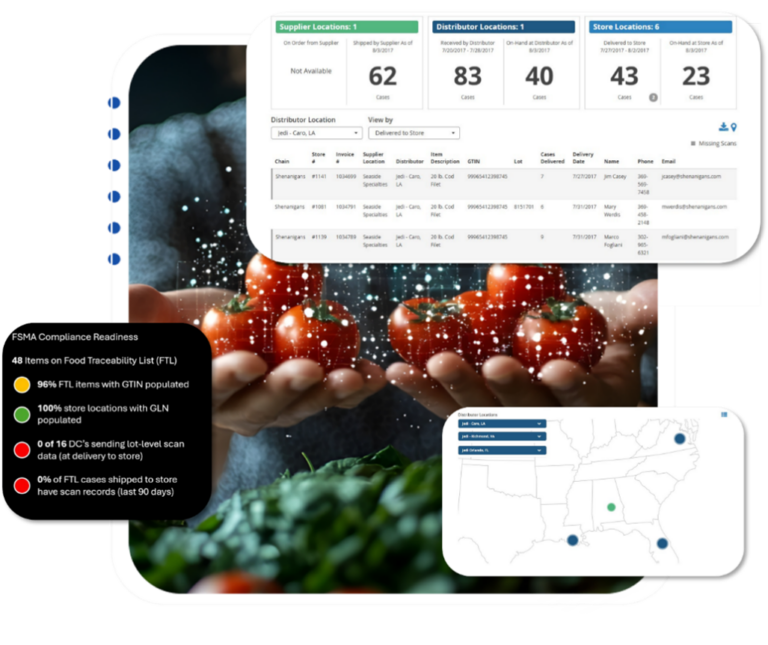
ArrowStream helps operators collect and organize traceability data from connected trading partners, making it easier to access the information needed to support FSMA 204 compliance.
What Foodservice Operators Should Do Before July 2028
Preparing for FSMA 204 starts with understanding your supply chain and the traceability data your operation will need to maintain. Before the compliance deadline, operators should:
- Identify foods on the Food Traceability List (FTL) used throughout their operation.
- Confirm distributors and suppliers can provide the required traceability data.
- Review receiving and recordkeeping processes to support compliance.
- Train staff on traceability procedures and documentation requirements.
- Work with technology partners, like ArrowStream, to simplify traceability and improve supply chain visibility.
- Create a written traceability plan: how you keep records, how you identify FTL foods, and a point of contact.
- Keep traceability records for 2 years.
Staying compliant with FSMA 204 doesn't have to be complicated—especially when ArrowStream has you covered.
As an ArrowStream customer working with a compliant distributor, you’ll have tools and support to ensure compliance with the minimum requirements while staying informed on future enhancements.
Additional questions? Contact us.
General FSMA 204 FAQs
The Food Safety Modernization Act (FSMA) is a U.S. law designed to improve food safety. It grants the FDA authority to regulate how food is grown, harvested, and processed.
The final rule establishes additional additional traceability recordkeeping requirements for those that manufacture, process, pack or hold certain foods, including fresh leafy greens, nut butters, fresh-cut fruits and vegetables and ready-to-eat deli salads. In collaboration with industry, the FDA will be able to more rapidly and effectively identify the origin and route of travel of certain contaminated foods to prevent or mitigate foodborne illness outbreaks, address credible threats of serious adverse health consequences or death, and minimize overly broad advisories or recalls that implicate unaffected food products.
Because the Food Traceability Final Rule requires entities to share information with other entities in their supply chain, the most effective and efficient way to implement the rule is to have all persons subject to the requirements come into compliance by the same date. The compliance date for all persons subject to the recordkeeping requirements was Tuesday, January 20, 2026. The original compliance date was January 20, 2026. Congress has directed the FDA not to enforce the rule before July 20, 2028, and the FDA has said it will follow that directive.
- Many fresh fruits and vegetables:
- Fresh cucumbers, herbs, leafy greens, melons, peppers, sprouts, tomatoes, tropical tree fruits, all fresh-cut fruits, and all fresh-cut vegetables
- A variety of soft cheeses:
- Fresh soft, soft un-ripened, soft ripened, and semi-soft cheeses made from pasteurized milk
- Cheeses made from unpasteurized milk, other than hard cheeses
- Shell eggs
- Nut butters
- Some categories of seafood:
- Fresh and frozen finfish, refrigerated and frozen smoked finfish, fresh and frozen crustaceans, and fresh and frozen molluscan shellfish and bivalves
- Refrigerated RTE (ready-to-eat) deli salads
- Harvesting
- Cooling
- Initial Packing (applies to Raw Agricultural Commodities not obtained from a fishing vessel)
- First Land-Based Receiver (applies only to seafood)
- Shipping
- Receiving – this is where ArrowStream will primarily assist
- Transformation
Every step in the process requires slightly different KDEs, but for the receiving at the restaurant location, it’s required to collect the following:
- Traceability lot code
- Quantity and unit of measure
- Product description
- Location description for the immediate previous source (other than a transporter)
- Location description for where the food was received
- Date received
- Location description for the traceability lot code source or the traceability lot code source reference
- Reference document type and reference document number
Create and maintain a traceability plan Maintain records as original paper records, electronic records, or true copies (must be legible and stored to prevent deterioration or loss).
- Provide traceability records (and any information necessary to understand these records) to the FDA no later than 24 hours after a request is made (or within a reasonable time to which the FDA has agreed).
- Provide an electronic sortable spreadsheet containing relevant traceability information to the FDA within 24 hours of a request (or within some reasonable time to which the FDA has agreed) when necessary to assist during an outbreak, recall, or other public health threat.
Restaurants are covered by FSMA 204 unless an exemption applies. In general, restaurants that receive foods on the Food Traceability List (FTL) must maintain required receiving records. Exemptions may vary based on your operation, sales volume, the foods you handle, and how those foods move through your supply chain. Refer to the FDA’s guidance to determine whether an exemption applies to your operation.
Beginning July 20, 2028, businesses covered by FSMA 204 are expected to comply with the Food Traceability Rule. If you’re unable to maintain or provide the required traceability records, you may be subject to FDA regulatory action. Preparing ahead of the compliance deadline can help reduce risk and ensure you’re ready to respond to FDA requests.
No. The FDA provides an electronic sortable spreadsheet template to help businesses respond to traceability data requests, but use of the template is optional. As long as you can provide the required traceability records in an electronic sortable format that meets FSMA 204 requirements, you do not need to use the FDA’s specific template.
For more information and the latest updates, you can consult the FDA website.
ArrowStream and FSMA 204 FAQs
ArrowStream is working closely with distributors to set up new data feeds and collect crucial traceability information for Key Data Elements (KDEs) like expiration dates, delivery dates, pack dates, and lot codes. Our approach aligns with the distributors’ FSMA timeline, ensuring a smooth transition.
Through this, ArrowStream will ensure that operator invoice data is connected directly to the lot codes for items on the FTL (Food Traceability List). This significantly enhances food traceability yielding several key benefits:
- Regulatory Compliance: Simplifies compliance with food safety laws and eases audit processes.
- Faster Recall Response: Quickly locate and isolate affected batches during recalls to protect customers.
- Supplier Accountability: Identify quality issues by batch, promoting consistent supplier quality.
- Customer Transparency: Share ingredient origins, meeting demands for food sourcing transparency.
ArrowStream is centralizing all data and developing easy-to-use search tools for quick access. We’re also looking at ways to expand traceability coverage, giving you more visibility than the basic requirements.
No. The KDE’s require a separate data feed from your distributors to be pulled into ArrowStream.
No. The distributor relationships are owned by the operator brands and buying groups.
ArrowStream is working with your distributors now to obtain data files on deliveries from their warehouses to your stores. Although we want to collect data quickly and accurately, we need your help.
You are the distributor’s customer and maintain the most leverage in the relationship. As you have conversations with key suppliers and distributors that have foods on the Food Traceability List, ask what they are doing to prepare for FSMA 204. Please share that you are working with ArrowStream to collect your data and ask them if they are actively sending data now.
If you have any questions, please work with your account manager and we will help you get the answers you need.
Yes. ArrowStream can still work with the distributor on behalf of the brand.
ArrowStream can still setup connections with these distributors, although there may be extra costs associated with it.
A Traceability Lot Code (TLC) is a unique identifier assigned to a specific lot of food on the Food Traceability List (FTL). It connects that food to the traceability records required under FSMA 204, helping businesses quickly identify and trace products throughout the supply chain during food safety investigations or recalls.
ArrowStream works with connected distributors to collect and organize the Key Data Elements (KDEs) required under FSMA 204. By connecting traceability data with operator invoice records, the platform provides faster access to the information needed to support FDA traceability requests, while improving visibility across the supply chain.