
Ask ten people in foodservice what the future of food looks like and you’ll get ten different answers. Some will say lab-grown burgers. Others will say robots in the kitchen. Most operators will just say, “Honestly, I’m trying to get through next week’s deliveries.”
All of those answers are fair. Back in 2022 we wrote about a handful of food-production innovations, like cultivated meat, animal-free egg whites and pasta that folds flat for shipping. Those stories still matter, but the bigger picture has grown. Climate, costs, technology, and customer expectations are all pushing the industry in new directions at once. Here’s how we see it, and what it means for the people who buy, prep and serve the food.
What Is Driving Change in the Food Industry?
Food doesn’t change on a whim. A few big pressures sit underneath almost everything you’ll read about in this post.
Population Growth and Rising Food Demand
There are simply more mouths to feed. One widely cited study estimated that global food demand could climb 35% to 56% between 2010 and 2050, and the UN expects the world population to approach 10 billion by mid-century. Producing that much food with the land and labor we have today isn’t realistic. Something has to give, which is why so much money is going into new ways of growing, making and moving food.
Climate and Resource Constraints
Weather has become a line item. Droughts, floods and heat waves hit crop yields, and water and farmland are getting harder to come by in plenty of regions. If you’ve watched the price of a single ingredient jump overnight, you’ve felt this firsthand. Producers are being asked to grow more with less, and that’s shaping nearly every trend below.
Changing Consumer Expectations
Guests want food that tastes great, costs a fair price and comes with a story they feel good about. They ask about sourcing. They read labels. And they expect plant-based options on the menu, and they notice when you don’t have them. Younger diners in particular tend to care a lot about where their food comes from, and operators are adjusting menus to match.
Food Supply Chain Disruptions and Resilience
The last few years taught everyone how fragile the chain can be. One closed plant or one stalled shipment can leave a menu item out of stock across hundreds of locations. Resilience used to be a nice-to-have. Now it’s part of the job, and we’ll come back to it because it’s where foodservice teams feel the future of food most directly.
Key Trends Shaping the Food Industry
Some of these trends are already on your plate. Others are still finding their footing. All of them are worth keeping an eye on.
Cultivated and Lab-Grown Meat
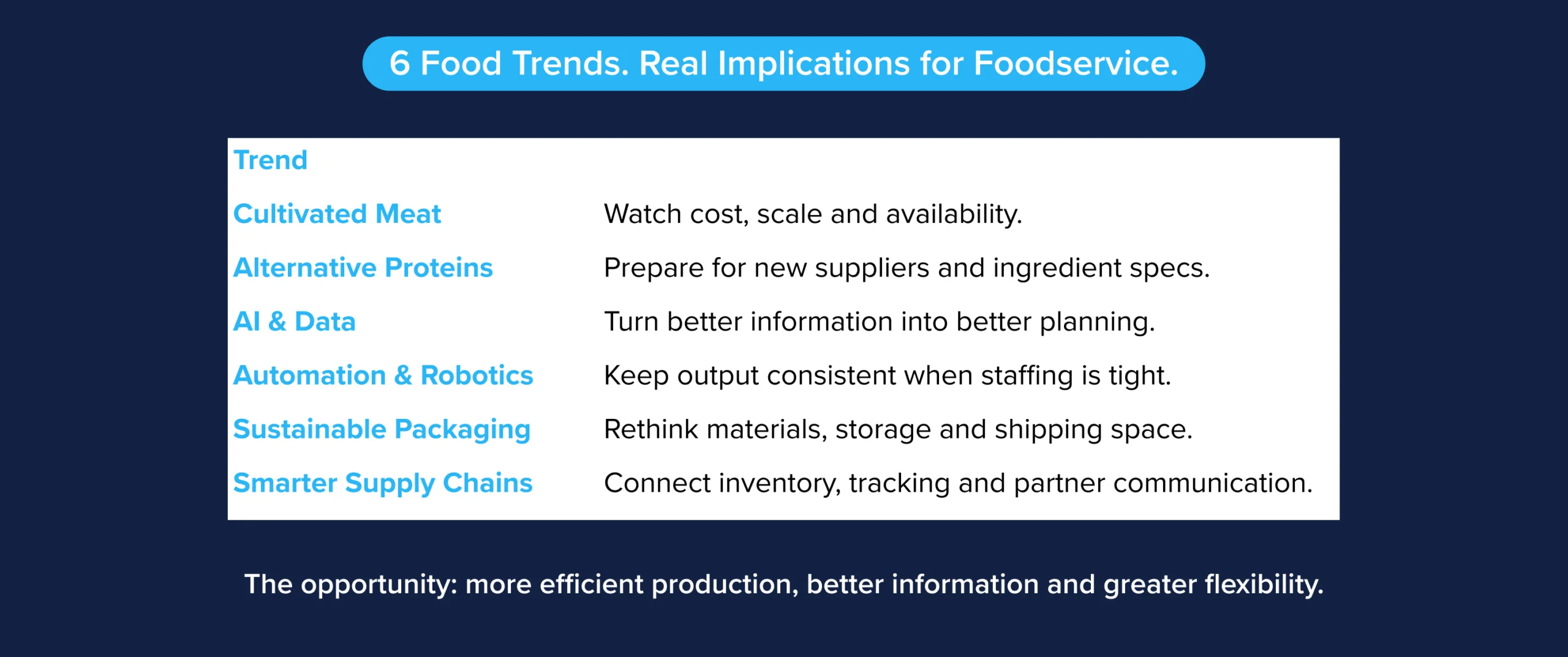
Cultivated meat is real animal meat grown from cells instead of raised on a farm. Early research suggested it could use far less land and water than traditional production, and companies have even experimented with species you’d never see at a butcher counter. The catch is scale. Getting the cost down and the volume up is the hard part, and regulators are still working out the rules. Expect it to show up first in small, specialty ways rather than replacing your protein line overnight.
Alternative and Animal-Free Proteins
This one’s moving faster. Companies like Every make egg proteins through fermentation, using yeast and sugar instead of hens. Plant-based and fermentation-based proteins are showing up in packaged foods and restaurant menus, and the ingredient lists behind them are getting longer and more specialized. For operators, that means new suppliers, new specs and new questions about consistency.
AI and Data-Driven Food Production
Farms and plants are starting to use sensors, satellite images and machine learning to decide when to plant, water and harvest. Food makers use similar tools to spot quality issues and cut waste on the line. Better data upstream tends to mean fewer surprises downstream, though it will take time before every grower and processor is on the same page.
Automation and Robotics in Food Production
Robots are already packing boxes, sorting produce and flipping burgers in some kitchens. Labor shortages are a big reason. Automation won’t replace the people who run great restaurants, but it can take over the repetitive, tough jobs and help teams keep output steady when staffing is tight.
Sustainable Food Packaging
Packaging is a quiet source of waste and cost. Compostable materials, lighter containers and smarter design are all in play. One of our favorite examples from the original post is the Carnegie Mellon research on flat-pressed pasta that curls into familiar shapes when it hits boiling water. Flat packs take up less space, so you ship more in each load and throw away less box.
Smarter Food Distribution and Supply Chains
Better routing, better tracking and better communication between partners mean fewer empty miles and fewer late trucks. Traceability is becoming a requirement too, with rules like FSMA 204 asking the industry to track certain foods more closely from source to shelf. The companies that can see what’s happening in their network will handle all of this a lot more calmly than those still working from spreadsheets.
The Role of Sustainability in the Food Industry
Sustainability used to be a side project. Today it’s tied to cost, brand and supply, and it’s hard to separate from the rest of the business.
Reducing Food Waste
A huge amount of food never gets eaten. It spoils in transit, sits too long in storage or gets prepped and tossed. Every pound of waste is money you already spent. Cutting it takes better forecasting, tighter inventory control and honest tracking of what’s actually being thrown away.
Using Water and Land More Efficiently
Growers are testing drip irrigation, vertical farms and precision tools that put water and nutrients exactly where a crop needs them. Cultivated and fermented proteins are also pitched as ways to cut down on land and water use. The goal is simple: get more food out of every acre and every gallon.
Reducing Food Production Emissions
Agriculture and food processing contribute a meaningful share of global greenhouse gas emissions. Producers are working on cleaner energy, lower-impact feed, closed-loop systems and shorter transport routes. Aleph Farms, which grew cultivated meat in space, pointed out that working under extreme limits pushed their team toward efficient, low-waste processes that now inform their work on Earth.
Adapting Food Production to Resource Constraints
Cutting impact is only half the story. The other half is adapting. That might mean switching crops, sourcing from new regions or redesigning recipes around ingredients that are easier to get. Flexibility is quickly becoming a sustainability strategy in its own right.
How Foodservice Supply Chains Are Evolving
All of the trends above land in the same place eventually: your back door. Here’s how supply chains for restaurants and other foodservice operators are changing.
Greater Need for Supply Chain Visibility
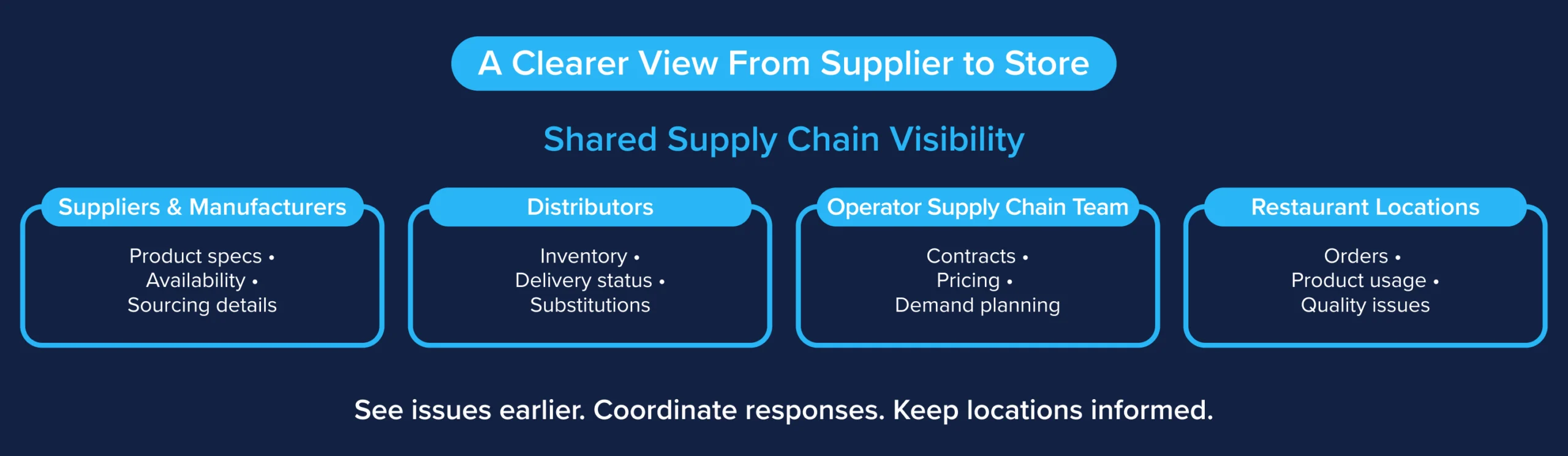
You can’t manage what you can’t see. Operators want to know what a distributor has on hand, what’s coming and what’s about to be short, before the truck shows up half full. Supply chain visibility is turning from a perk into a basic expectation.
More Complex Ingredient and Supplier Networks
Add a plant-based protein here, a specialty sauce there, a regional produce partner for a limited-time offer, and suddenly your supplier list has doubled. More ingredients mean more contracts, more pricing, more specs and more places for things to slip through the cracks.
Demand for More Sustainable Sourcing
Guests ask. Boards ask. Investors ask. Teams are being expected to show where ingredients come from and how they were produced, and that takes data from suppliers that has to be collected and kept in order.
Better Forecasting and Inventory Management
Over-ordering ties up cash and ends up in the dumpster. Under-ordering leads to 86’d items and unhappy guests. Better forecasting, built on real sales, real inventory and real market trends, is the way out. It matters even more when you’re planning a promotion or limited-time offer.
Preparing for Future Supply Disruptions
Disruptions will keep happening. Weather, recalls, labor gaps, port delays, you name it. The operators who do well aren’t the ones who avoid every problem. They’re the ones who spot it early and already have a plan B.
How Foodservice Businesses Can Prepare for the Future
You don’t need to wait for lab-grown steak to show up at your distributor to get ready. The smartest moves are practical ones, and you can start on them now. This is the work we do every day at ArrowStream, where our cloud platform connects restaurants, manufacturers and distributors in North America’s largest foodservice network, with more than 150,000 operator locations.
Invest in Supply Chain Visibility
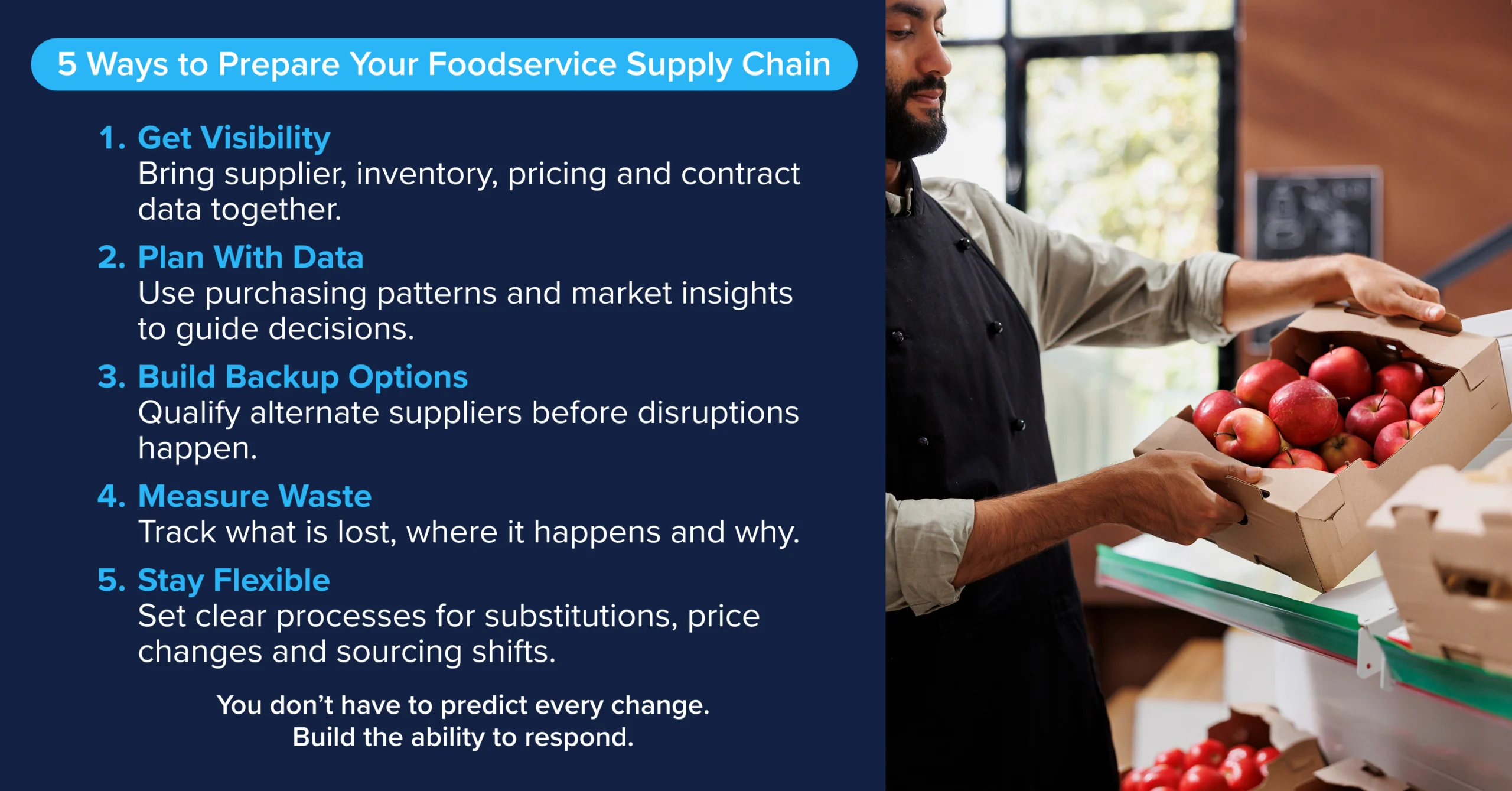
Start here, because everything else depends on it. When location, supplier and product data live in different spreadsheets, inboxes and phone calls, problems get found late. ArrowStream Central pulls that information into one place so your team can see distributor inventory, pricing and contracts together and catch a possible stock-out or substitution before it hits the store. As one of our customers, SVP of Supply Chain Jeremy Lyle, put it, “It’s given us time to do things proactively as opposed to reactively.” That’s what good visibility feels like in practice.
Use Data to Improve Forecasting and Planning
Gut feel will only get you so far, especially with more ingredients and more price swings to juggle. Use your actual purchasing and inventory data to forecast demand, and layer in market insight on commodity prices so you aren’t caught off guard. It also helps you right-size inventory for promotions and LTOs, so a great campaign doesn’t leave you sitting on a pile of product afterward. Our platform pairs clean, consolidated data with price forecasting and AI-driven insight to help buying teams make those calls with more confidence.
Diversify Suppliers and Sourcing Options
Relying on one source for a key item is a risk you can feel the moment something goes wrong. Build a bench of qualified alternates, and know who they are before you need them. Inside ArrowStream Central, operators can discover new suppliers, track how current ones are performing and connect with sources for new or substitute products. That makes switching a plan instead of a scramble.
Track Sustainability and Waste
If you aren’t measuring waste, you’re probably underestimating it. Start with the basics: what’s being thrown out, where and why. Add supplier sourcing details as your customers and leadership start asking for them. Tracking quality and service incidents at the store level helps too, since damaged or short deliveries are a real source of waste and lost credits. When you have the numbers, it’s far easier to set goals that stick.
Build Flexibility into Procurement and Operations
Rigid plans break. Flexible ones bend. Leave room in your contracts, menus and ordering habits for substitutions and shifting prices, and make sure your team has a clear process for handling them. Catching pricing mistakes early is part of that, because invoices that don’t match contracted terms can quietly add up to a lot of money. Teams that stay nimble can say yes to new ingredients and trends without putting their margins at risk.
Conclusion
The future of food won’t arrive in one big moment. It’s a pile of changes, some loud and some quiet, from alternative proteins and automation to smarter packaging and tighter supply chains. What connects them is the need for better information and more flexibility at every step.
You can’t control the weather or the next big food trend. You can control how well you see your supply chain and how fast your team can react. If you want to see what that looks like for your business, connect with an ArrowStream expert and find out how the largest foodservice network in North America can help you get ahead of what’s coming.
FAQ’s
What are the biggest trends shaping the future of food?
The big ones are alternative and animal-free proteins, cultivated meat, AI and automation, sustainable packaging and smarter supply chains. Underneath them are population growth, climate pressure and changing guest expectations.
How will technology change the way food is produced and distributed?
Technology will help growers and producers use fewer resources, spot quality problems sooner and waste less. In distribution, better tracking and data sharing give operators a clearer view of inventory, pricing and delivery status.
Will alternative proteins become more common in the food industry?
Most likely, yes. Plant-based and fermentation-based proteins are already growing on menus and in grocery aisles. Cultivated meat will probably take longer because of cost, scale and regulation.
How will sustainability affect the future of food production?
It will shape how food is grown, packaged and shipped. Expect more focus on cutting waste, using less water and land, lowering emissions and showing customers where ingredients come from.
How will supply chains change as the food industry evolves?
They’ll get more connected and more data-driven. Operators will expect real-time visibility, more flexible sourcing and better tools for forecasting and handling disruptions.
How can foodservice businesses prepare for changes in the food industry?
Get a clear view of your supply chain, use your data to forecast and plan, line up backup suppliers, track waste and sustainability, and keep procurement flexible. A platform like ArrowStream Central can help bring all of that together.