
In foodservice, there are plenty of things you can flex on. Your cold chain is not one of them.
If product temperature slips at any point, it’s not just a small issue. It turns into waste, credits, missed service expectations, and sometimes much bigger problems.
That’s why cold chain management in food industry operations isn’t just a logistics function. It’s a direct line to food safety, product quality, and your bottom line.
What is Cold Chain Management in the Food Industry?
Cold chain management in the food industry is the process of keeping temperature-sensitive products within a specific range from the moment they’re produced all the way through delivery.
It covers everything. Supplier handling. Storage. Transportation. Distribution. Final delivery.
If even one link in that chain breaks, the product might still look fine, but you’ve already lost time, quality, and in some cases, compliance.
How Cold Chain Management Works Across Foodservice Distribution Networks
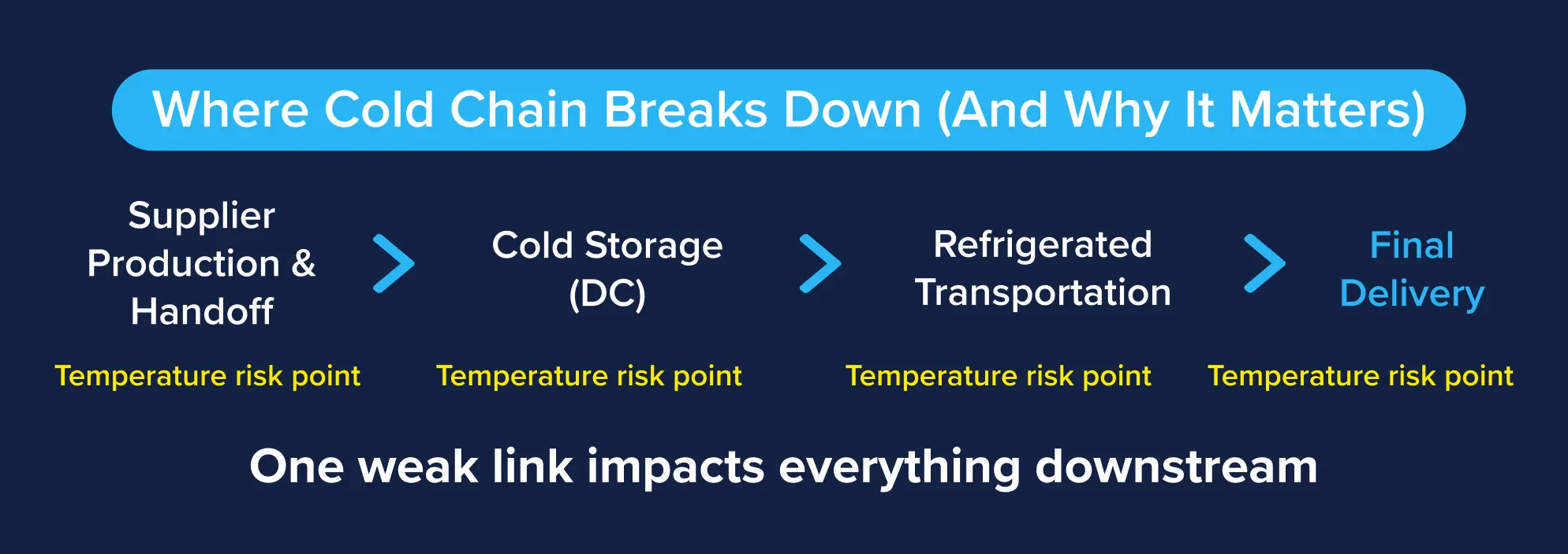
Cold chain management in food industry distribution isn’t one step. It’s a series of handoffs. And every handoff is a risk point if it’s not managed tightly.
Temperature Control at Production and Supplier Handoffs
It starts at the source. If product leaves the supplier outside the correct temperature range, everything downstream is already compromised.
This is where proper packaging, pre-cooling, and clear documentation matter more than people think.
Cold Storage and Refrigerated Distribution Centers
Once product hits a distribution center, it should move into controlled storage immediately.
That means consistent refrigeration, proper rotation, and zero shortcuts during receiving. Because that “quick unload” is usually where problems sneak in.
Refrigerated Transportation and Linehaul Distribution
Now it’s on the road.
Refrigerated trailers have to maintain stable temperatures across long distances, changing climates, and tight delivery schedules. If equipment isn’t dialed in, small fluctuations can turn into big losses.
Final Distribution and Customer Delivery Handoffs
Last mile matters just as much as first mile.
If product sits too long on a dock or gets rushed during delivery, all the work upstream gets undone. This is where execution and accountability show up fast.
Why Cold Chain Management is Critical for Foodservice Distributors
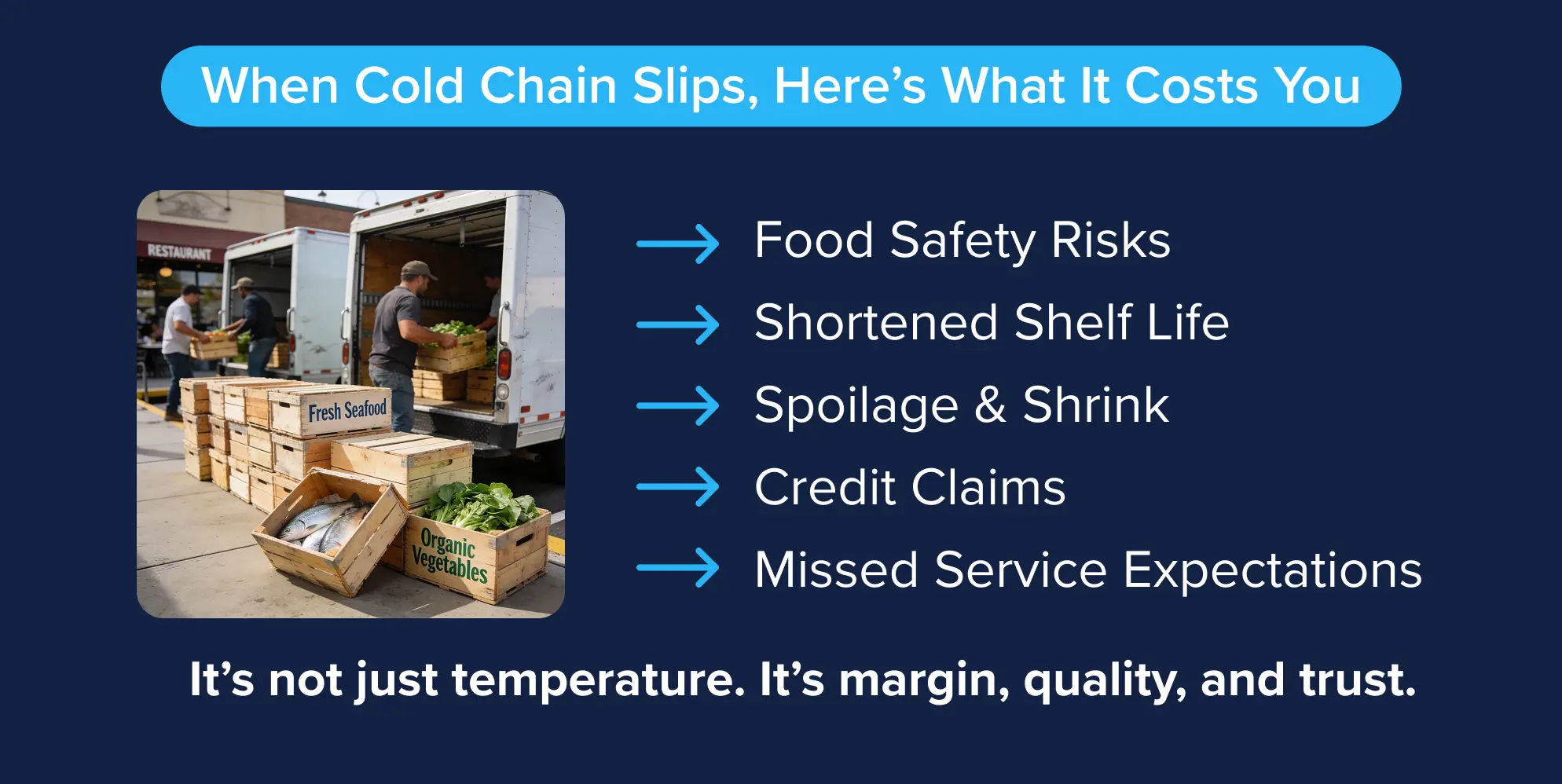
Cold chain management in food industry operations hits multiple pressure points at once.
Food Safety, Compliance, and Recall Risk Mitigation
Temperature control isn’t optional. It’s tied directly to food safety standards and regulatory requirements.
If something goes wrong, you’re not just dealing with product loss. You’re dealing with compliance risk and potential recalls.
Protecting Product Quality and Shelf Life at Scale
When temperature stays consistent, product performs the way it should.
Shelf life holds. Quality stays intact. Kitchens get what they expect.
When it doesn’t, operators feel it immediately.
Reducing Shrinkage, Spoilage, and Credit Losses
Shrink rarely shows up all at once. It builds quietly.
A few pallets here. A few cases there. Over time, it adds up to real dollars walking out the door.
Maintaining Service Levels and Customer Trust
At the end of the day, your customers don’t care about your logistics challenges.
They care that product shows up right. Every time.
Cold chain consistency is what makes that happen.
Core Components of an Effective Cold Chain for Distributors
Strong cold chain management in food industry distribution doesn’t happen by accident. It’s built intentionally.
End-to-End Temperature Monitoring and Exception Tracking
You need to know what’s happening at every step, not just when something goes wrong.
Real-time monitoring helps you catch issues early instead of reacting after the damage is done.
Traceability, Documentation, and Audit Readiness
When questions come up, you need answers fast.
That means clean records, clear traceability, and the ability to show exactly where product has been and how it was handled.
Network-Wide Visibility and Control
Disconnected systems make everything harder.
The more visibility you have across suppliers, carriers, and distribution points, the easier it is to stay ahead of problems.
Cold Storage Infrastructure and Equipment Reliability
Even the best processes fall apart if the equipment doesn’t hold up.
Reliable refrigeration, backup systems, and routine checks are non-negotiable.
Standardized Operating Procedures Across Distribution Locations
Consistency behind the scenes creates consistency in delivery.
When every location follows the same playbook, performance becomes predictable.
Accountability Across Suppliers, Carriers, and Internal Teams
Everyone touches the product. Everyone owns a piece of the outcome.
Clear ownership at each step prevents things from slipping through the cracks.
Common Cold Chain Challenges in Foodservice Distribution
Even well-run operations run into friction points.
Temperature Excursions and Equipment Failures
It only takes one equipment issue or delay to create a temperature excursion.
And those are often discovered after the fact, which makes them expensive.
Limited Visibility Across Carriers and Routes
When product leaves your facility, visibility can drop fast.
Without consistent tracking, you’re relying on updates instead of data.
Managing Mixed Temperature Requirements at Scale
Frozen, refrigerated, and ambient products all moving together adds complexity.
It requires tight coordination and clear separation to keep everything within spec.
Rising Transportation, Fuel, and Energy Costs
Cold chain management in food industry operations is energy-intensive.
As costs rise, the pressure to run more efficiently gets even higher.
Cold Chain Best Practices for Foodservice Distributors
There’s no silver bullet, but there are habits that separate strong operators from reactive ones.
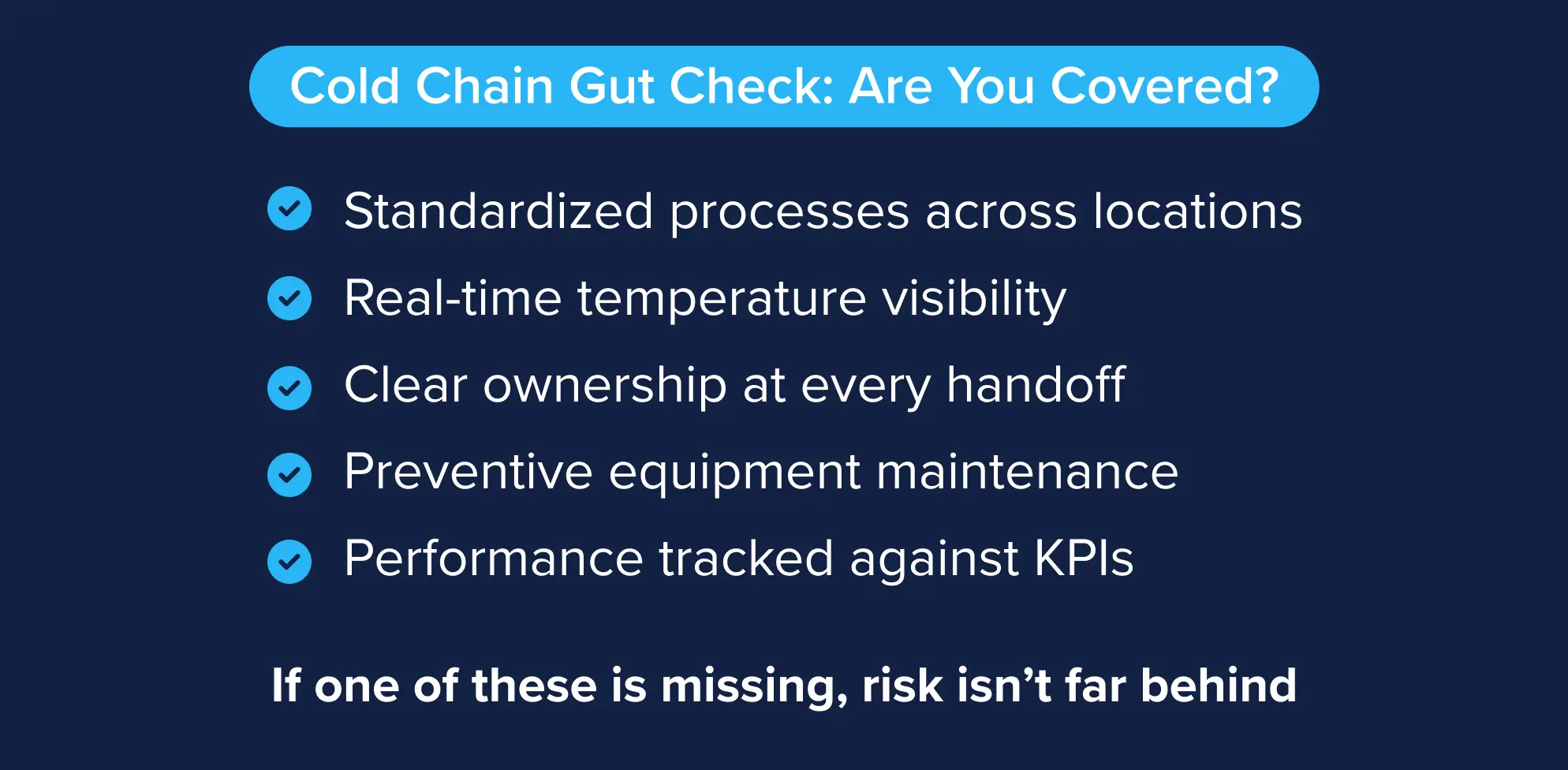
Standardize Cold Chain Processes Across Distribution Networks
When processes vary by location, performance does too.
Standardization keeps everyone aligned and reduces variability.
Proactively Identify and Resolve Temperature Exceptions
If you only find out there’s a problem after a credit hits your desk, you’re already behind.
The goal is to catch temperature issues while the product is still moving through the system, not after it’s been received or rejected. Spot it early, fix it fast, and you save yourself the headache of dealing with spoiled product later.
Establish Clear Ownership at Every Cold Chain Handoff
Every handoff should have a name attached to it.
That clarity speeds up decision-making and reduces finger-pointing later.
Use Data to Reduce Shrink and Improve Throughput
Data makes cold chain performance easier to manage because it shows where losses, delays, and inefficiencies are actually happening. Instead of relying on assumptions, distributors can use temperature data, dwell time trends, delivery performance, and spoilage patterns to pinpoint where product is most at risk.
That visibility helps teams reduce shrink before it compounds. If certain routes, facilities, carriers, or handoff points consistently create issues, data makes those patterns easier to catch and correct.
It also improves throughput. When teams can identify where product is sitting too long, where delays are most common, or where operational bottlenecks are slowing movement, they can make adjustments that keep inventory moving without compromising temperature integrity.
Used well, data does more than explain what went wrong. It helps distributors make faster decisions, tighten execution, and run a more efficient cold chain overall.
Implement Preventive Maintenance and Equipment Readiness Programs
If a unit goes down in the middle of a run, you’re not just fixing equipment, you’re dealing with product loss and delivery issues at the same time.
Staying ahead of maintenance keeps things running the way they should. Regular checks, quick fixes, and making sure everything is ready before it’s needed goes a long way in avoiding bigger problems later.
Continuously Measure Cold Chain Performance Against KPIs
If you’re not measuring it, you can’t improve it.
Temperature compliance rates, dwell time, and spoilage trends all tell a story worth paying attention to.
How Supply Chain Intelligence Improves Cold Chain Management
Cold chain management in food industry distribution gets a lot easier when teams have a clearer view of what is happening across the network.
Supply chain intelligence brings together data from suppliers, distribution centers, transportation partners, and delivery points so distributors can monitor performance in context rather than in silos. That matters because cold chain issues rarely start and end in one place. A delay at pickup, inconsistent storage practices, or poor in-transit visibility can all create downstream problems that affect quality, service, and cost.
With stronger supply chain intelligence, distributors can identify recurring risks earlier, respond to temperature exceptions faster, and understand how disruptions in one part of the network impact the rest of the operation.
It also supports better decision-making over time. Instead of reacting to spoilage, credits, or service failures after they happen, teams can use network-level insights to improve routing, strengthen supplier and carrier accountability, and refine cold chain processes across locations.
In practical terms, supply chain intelligence helps turn cold chain management from a reactive exercise into a more proactive, controlled, and measurable part of the business.
Future of Cold Chain Management in Foodservice Distribution
The next wave of cold chain management in food industry operations is already taking shape.
Sensor-Driven and IoT-Enabled Cold Chains
Sensors are getting smarter and more accessible.
That means real-time temperature tracking is becoming standard, not a luxury.
Predictive and Prescriptive Supply Chain Intelligence
It’s not just about seeing what happened.
It’s about knowing what’s likely to happen next and what to do about it.
Sustainability and Energy Efficiency in Cold Logistics
Energy use is under a microscope.
Operators are looking for ways to maintain cold chain performance while reducing environmental impact and cost.
Final Thoughts
Cold chain management in food industry distribution is not just about keeping product cold. It is about protecting product quality, preserving shelf life, reducing avoidable loss, and delivering the consistency customers expect.
When cold chain execution breaks down, the impact spreads quickly. Shrink increases, service suffers, credits rise, and trust becomes harder to maintain.
The distributors that stay ahead are the ones that treat cold chain as an operational priority across the full network, from supplier handoff to final delivery. They invest in visibility, standardization, accountability, and the data needed to catch issues before they become bigger problems.
Because when temperature control is consistent, operations are stronger, margins are better protected, and customers feel the difference.
Ready to strengthen your cold chain with better visibility and control? Click here to see how Crossbow helps foodservice distributors connect inbound analytics, transportation workflows, and real-time insights in one platform—so you can reduce shrink, improve throughput, and stay ahead of cold chain disruptions.
FAQs
Why is cold chain management important for distributors?
Because once temperature control slips, everything else starts to unravel. Product doesn’t last as long, quality takes a hit, and now you’re dealing with credits, complaints, and potential compliance issues. Strong cold chain management in food industry operations keeps product consistent and protects your margins at the same time.
Which food products require strict cold chain control?
Anything perishable. Think proteins, dairy, fresh produce, and frozen items. If it can spoil, it needs to stay within a tight temperature range from start to finish. Even a short stretch outside that range can shorten shelf life or create quality issues by the time it hits the kitchen.
What are the biggest cold chain risks in food distribution?
Most of the trouble comes from small breakdowns along the way. A trailer running warm, a delay at a dock, equipment not holding temp, or not having clear visibility once product is in transit. None of it seems huge in the moment, but it adds up fast and usually shows up as spoilage or credits later.