

Advances in technology have made modern restaurants synonymous with digital menu boards, self-ordering kiosks, and dashboards that provide managers real-time operational insights. And while flashy reporting platforms and complex analytics tools can certainly improve visibility, these tools alone don’t create operational control. After all, what good is the ability to track purchasing activity across hundreds of locations if it’s not clear how to make actionable improvements in your restaurants?
This is where automation changes the equation. Instead of simply highlighting existing problems, automation transforms supply chain data into operational workflows, triggering processes to address issues as they are identified, rather than weeks later during a period-end review. For corporate supply chain leaders responsible for protecting margins at scale, understanding how to leverage automation to maintain operational control can help you move from simply monitoring your supply chain to actively managing it.
Where Supply Chain Visibility Breaks Down
Enterprise restaurant leaders have access to more data than ever before. Pricing reports, distributor data, purchasing dashboards, and supplier performance metrics all provide valuable insights into how products move through the system. On the surface, this level of reporting creates the illusion of a highly visible, tightly controlled organization.
But in many organizations, visibility exists more as a technological capability than a true operational advantage. Critical information often lives across multiple systems managed by different teams. While each source provides useful visibility on its own, the lack of integration makes it difficult to translate insights into coordinated action.
The scale of enterprise restaurant supply chains only amplifies this challenge. With hundreds or thousands of locations placing orders, working with distributors, and operating under varying purchasing habits, even small deviations can quickly multiply across the network. Without systems that connect visibility directly to operational workflows, supply chain teams may be able to identify discrepancies, but still struggle to correct them consistently. In many cases, this is where organizations become stagnant. They reach a point of technical visibility that makes them “data-aware” but then hit a technical plateau on how to continue building momentum in their operations.
The Shift from Data-Aware to Data-Optimized
Many foodservice organizations today consider themselves “technology forward,” but in practice, they often operate at very different levels of data maturity. Understanding these stages can help supply chain leaders identify where their organization currently stands and where the greatest opportunities for improvement exist.
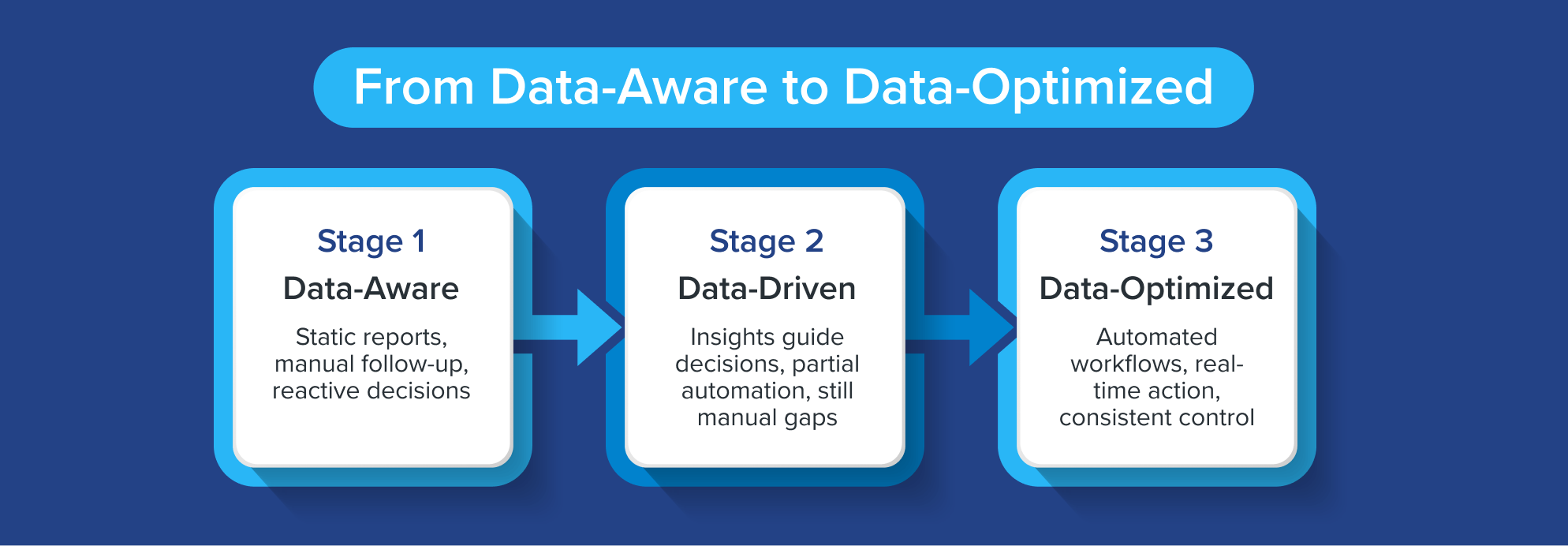
- Data-aware organizations have access to information but primarily use it for observation. Data often lives in static reports or spreadsheets, requiring manual interpretation and follow-up before action can be taken.
- Data-driven organizations go a step further by using insights to inform decisions. Some fundamental automated reports exist to help leaders identify patterns and make strategic operational adjustments, but several key aspects of the operation still rely heavily on human intervention and manual execution.
- Data-optimized organizations close the gap between insight and action. In these environments, automation and centralized systems support real-time improvement through workflows that control core aspects of the business, such as purchasing behavior or compliance enforcement.
Once an organization reaches the data-optimized stage, they often benefit from:
- Faster response to price fluctuations and supplier issues
- Greater contract compliance across locations
- Reduced manual reporting and administrative work
- More consistent purchasing behavior across the network
- Improved operational control with more consistent profitability
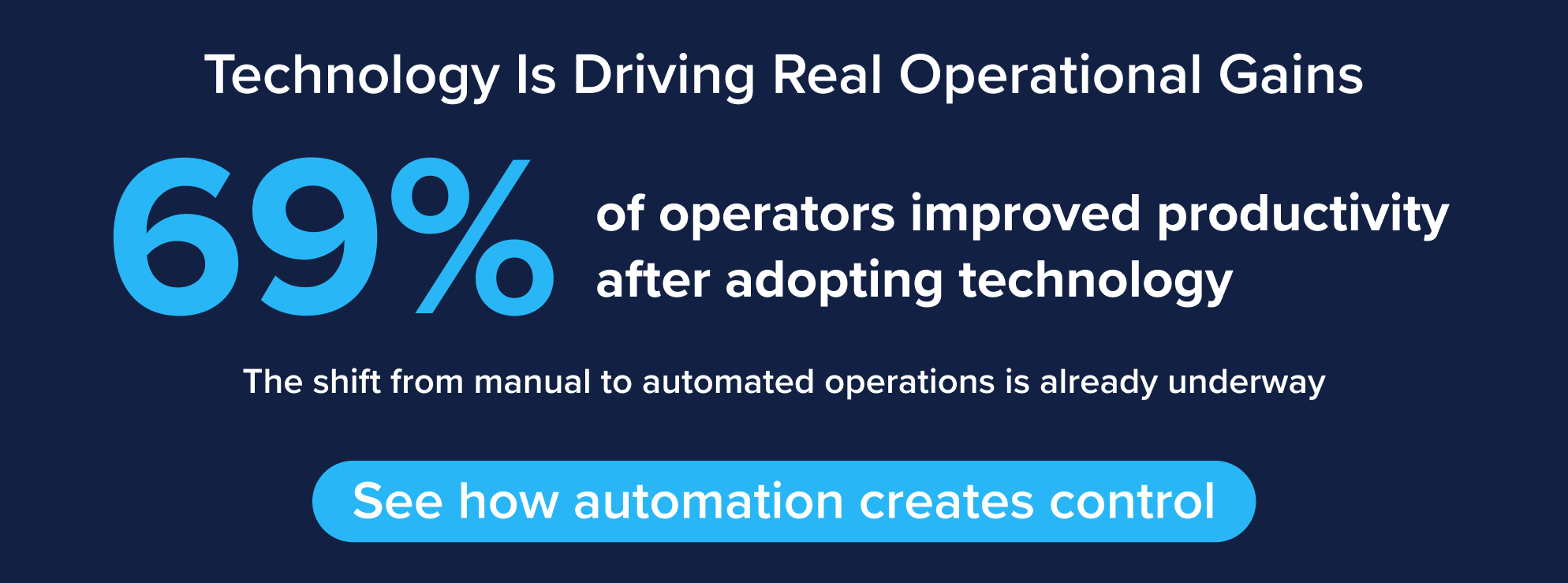
Moving from data-aware to data-optimized ultimately allows operators to transform information into measurable operational improvements.
What Automation Actually Means in Enterprise Supply Chains
When leaders hear the word automation, they often associate it with replacing human roles or removing decision-making from the process. In complex enterprise supply chains, however, the real value of automation lies in reducing the time between deviation and correction. Small deviations can go unnoticed and are often minor at first, but when they go unchecked for weeks, or they compound across hundreds of locations, they can quietly erode margins.
Rather than replacing people, automation helps close the gap between an issue going off track (deviation) and an action taken to fix it (correction). For example, consider the impact of an unexpected price increase on a key ingredient. With a manual system, the variance might not be discovered until weeks later in an end-of-period report. If the price of that key ingredient increased by a mere $0.50 per unit, such a minor change in a single location may not even be noticed. But if that ingredient is used at an average of 40 units per month across 120 locations, the organization could potentially incur $2,400 in cost overages in just one month before the issue is identified and corrected. If that same discrepancy goes unnoticed (or unaddressed) for six months, the impact of that seemingly trivial increase rises to $14,400 in excess cost for a single ingredient.
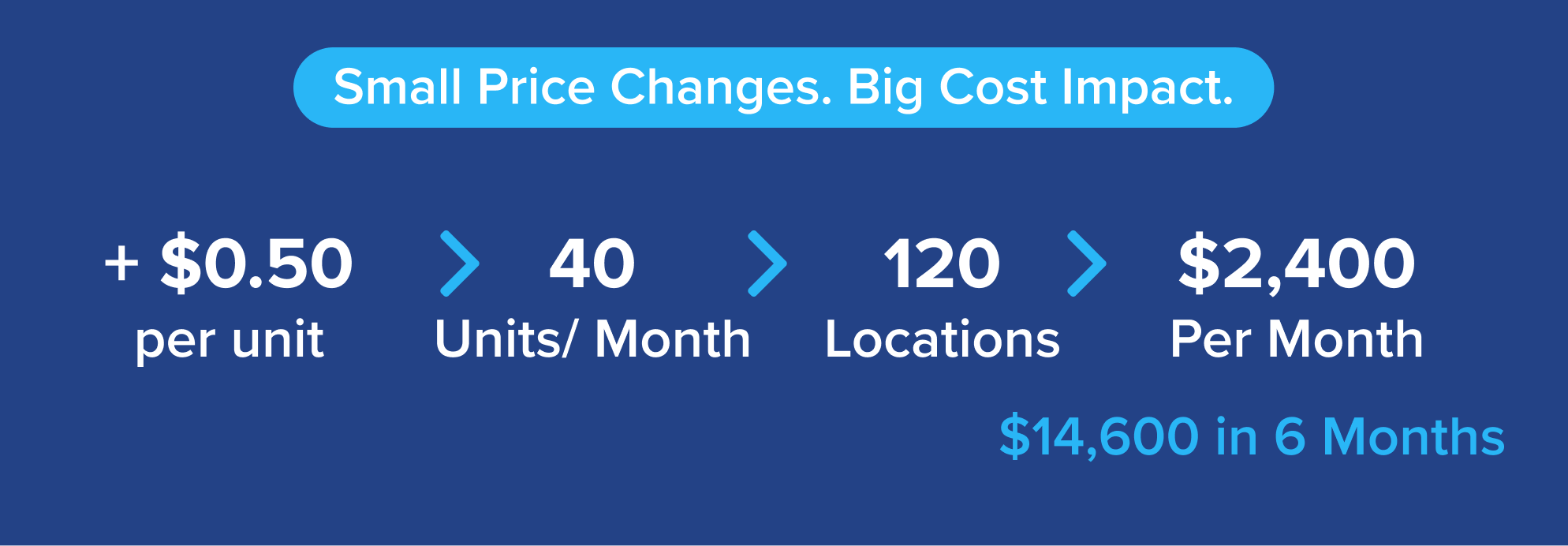
Instead, with an automated purchasing system, the variance triggers a workflow to immediately notify the procurement team so they can investigate the cause and take appropriate action with the distributor. By shortening the time between insight and action, automation allows supply chain teams to focus less on searching for problems and more on solving them.
Where Visibility and Automation Intersect
When restaurant organizations combine strong supply chain visibility with effective automation, they unlock the ability to respond quickly and consistently to changing conditions. Visibility helps leaders understand what is happening across the supply chain, while automation ensures that insights can be acted on before small issues grow into larger financial problems.
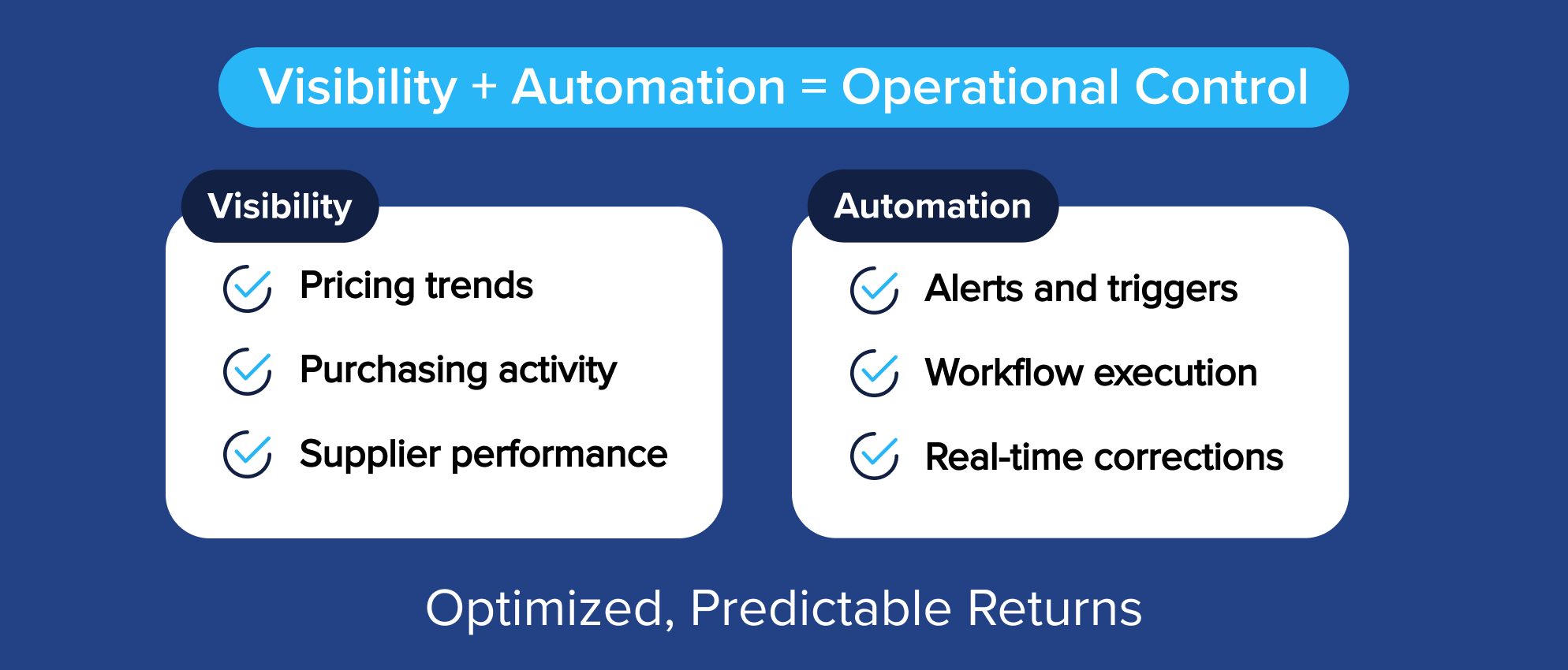
At its core, the relationship can be summarized with a simple formula:
High Visibility + High Automation → Optimized, Predictable Returns
When the purchasing activity, pricing trends, and supplier performance metrics available to operators are combined with systems designed to automatically flag issues and guide corrective action, supply chain management becomes far more proactive. Instead of reacting to problems once they cause noticeable impact to the bottom line, teams can address issues early and maintain tighter control over costs.
The challenge is that most restaurant organizations don’t fully operate at this intersection. Some have strong reporting and analytics but are still relying on primarily manual operational processes. Others automate key processes but lack the end-to-end visibility needed to guide those systems effectively. The brands that achieve the most consistent financial outcomes are those that intentionally build both capabilities together.
Signs That Your Supply Chain Is Ready for Automation
Many restaurant organizations already have the data needed to improve supply chain performance, but turning that data into consistent action can be difficult. If your team can identify issues but struggles to correct them quickly or consistently, it may be a sign that your supply chain has reached the limits of manual processes.
Here are some common signs that automation could help close your existing operational gaps:
- Teams spend hours reconciling reports across multiple data sources
- Price variances are discovered weeks after the initial purchase
- Contract pricing exists, but compliance varies across locations
- Locations often order outside approved supplier or product lists
- Teams identify issues but struggle to implement corrective action
- Purchasing behavior differs between locations within the same brand
- Teams rely heavily on spreadsheets to monitor inventory patterns
If you identified three or more of these common patterns in your own operation, this is a strong indicator that automation could help stabilize your business and provide stronger, more predictable performance across your supply chain network.
Building Your Data-Optimized Supply Chain
Supply chain volatility is a reality in the restaurant industry. Prices fluctuate, suppliers adjust availability, and purchasing patterns shift across locations. Savvy operators know that preventing these disruptions entirely is impossible, so the key is to detect and correct them before they can impact your bottom line.
That’s where the combination of visibility and automation becomes so powerful. Visibility helps organizations understand what’s happening across the network, while automation helps teams respond quickly and consistently. To explore how leading brands are building that transition, download the full guide, Driving ROI Through Data-Driven Supply Chain Strategy, and start building a practical roadmap toward a more controlled, data-optimized supply chain.