

We frequently hear chain restaurant operators tell us that they don’t run sourcing events, requests for information (RFIs) or requests for proposals (RFPs), when in fact they do. Oftentimes, what they really mean is that they don’t have a formal process or strategy in place that they call “sourcing.” And that’s okay. Whatever form your company’s sourcing event, RFI or RFP takes, it’s just important that you, as an operator, do it.
Whether you’re part of a supply chain procurement, culinary or quality assurance team, the following is designed to help operators start small, so they can more easily reach their business objectives and build a structured process and strategy that works for their brand(s).
What is Restaurant Sourcing and Why It Matters
Foodservice sourcing is a strategic process that secures the right product at the best price and quality. This process includes sending inquiries, running events, RFIs or RFPs.
Depending on your role, the circumstance, or goal, there are several reasons why operators would want to source.
For instance, an operator might want to:
- Research qualified suppliers. You may not know which suppliers may be the right fit or who can meet your product or capacity specifications. Sending inquiries ahead of inviting them to your sourcing event can reduce research time and quickly find qualified partners to invite to participate in your event.
- Look for a new product. Limited time offers (LTOs), new menu items, or quality or operational issues with an existing product or supplier could mean you need to source a new product and potentially a new vendor.
- Validate that a current supplier is the best fit. Relationships matter, and customers should trust their suppliers. However, businesses change, and it’s important to verify that your partners are still the best for your organization. This could be from a price, quality or service-level standpoint.
- Test the market to ensure a fair price. Just like businesses change, so do the markets. Commodity markets can be volatile and drastically affect prices. If you’ve been using the same supplier for the last few years, sourcing can help to negotiate a new price with your existing supplier, or you might decide to change suppliers.
- Ensure a back-up supplier. Whether a product is affected by a quality issue, weather phenomenon or another market disruption, having a second supplier to call on will help to ensure you’re prepared for uninterrupted service and quality for your customers.
How to Start & Organize a Sourcing Strategy
Using a modified version of a Kraljic Matrix, below is a visual tool to guide customers through starting a sourcing process and to engage them in thinking holistically about the foodservice supply chain. The matrix provides a way to categorize products in your supply chain by level of risk and criticality to your business and determine the right strategy.
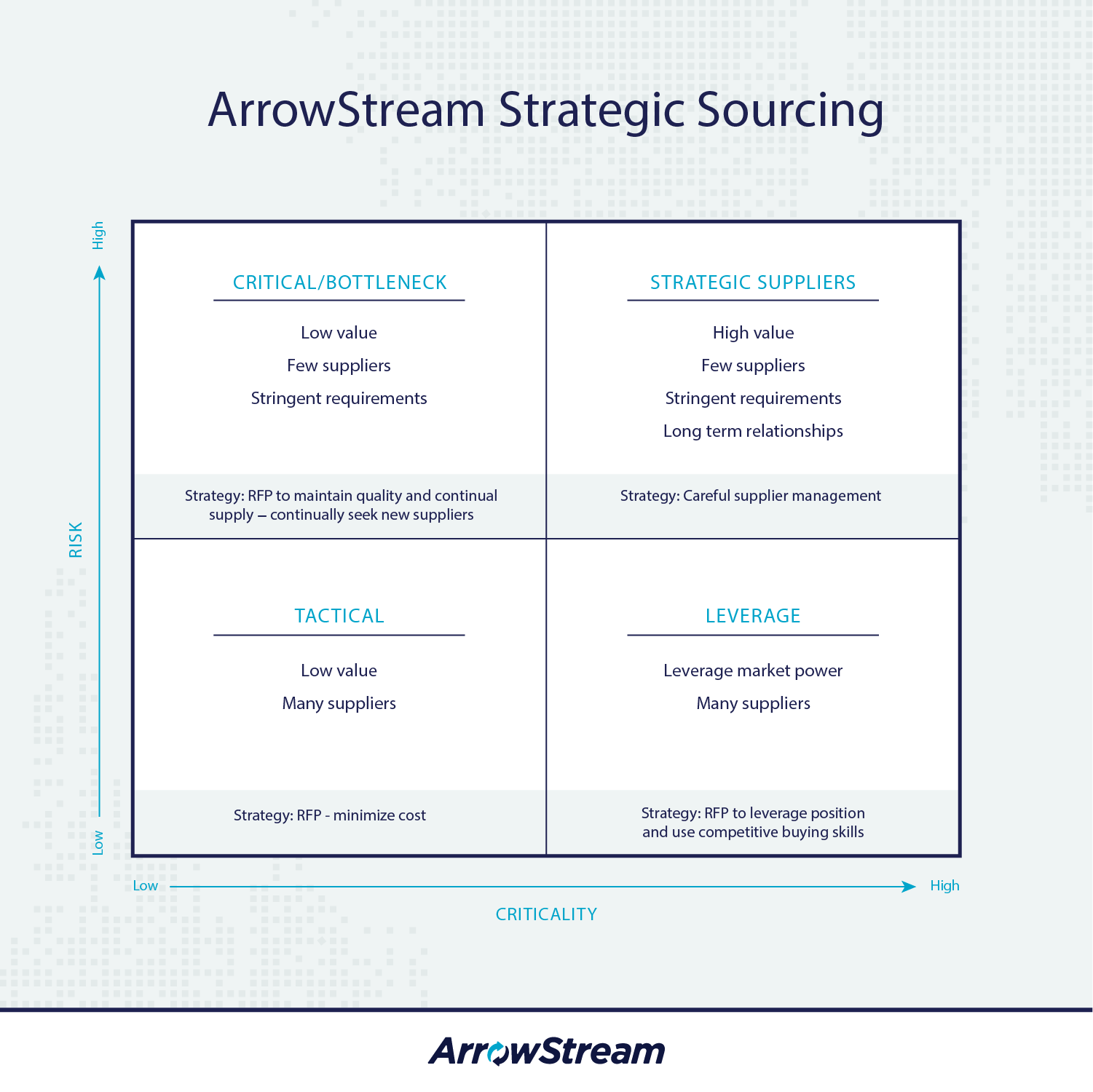
Customers who are new to sourcing are encouraged to begin with products they believe would fall in the low risk, low criticality box. Every operator will be different, but typical examples of low risk, low criticality items might be non-center-of-the-plate or non-food items, such as straws, garbage can liners, or lettuce for a burger. For items in this box, operators might choose to run a sourcing event with a strategy to minimize their costs.
6 Best Practices to Improve Your Sourcing Strategy
1. Establish a Plan by Creating a Sourcing Calendar
By having a calendar dedicated to sourcing, it allows operators to plan ahead and turn a manual sourcing process into a repeatable process. By being more proactive, you can give yourself plenty of lead time before a contract expires to assign internal resources to the sourcing event and to assess multiple suppliers. This is especially important if an incumbent supplier doesn’t retain your business; there is then enough time to get samples and approve a new vendor’s product.
2. Run a Sourcing Event to Validate the Best Fit for Your Organization
Validate that your current supplier is the best fit for your organization, whether that’s based on price, quality or service. Although operators and suppliers work to establish trust, it’s still vital to verify that they are the best supplier for your organization and to test the market to ensure you’re getting a fair price, or the best quality or service.
3. Invite Several Suppliers to Participate in Sourcing Events
When running a sourcing event, it’s important to invite numerous suppliers. This method will ensure you have enough competition to validate the suppliers that are the best fit for your organization. Finding new suppliers can be tough, so having access to a foodservice supplier database will not only save time, but ensure peace of mind that you’re inviting a verified supplier who works in the restaurant industry.
4. Round Up Non-Contracted Items
Put items that aren’t currently contracted under contract in order to create a standardized product for all restaurants and keep pricing consistent across the system. Studies have found that the largest savings from sourcing events don’t come from the “center of plate” items but rather the less critical items and can often yield large, unexpected savings simply since they have not been focused on.
5. Limit the Number of Bidding Rounds
By running too many bidding rounds on a sourcing event, participating suppliers may feel like you’re trying to run the price down, which can damage the trust between the supplier and your organization. Instead, set a limit on the number of bidding rounds and focus on your goal for setting up the sourcing event, which may not always be to receive the lowest price.
6. Consider a Sourcing Tool Tailored for the Foodservice Industry
ArrowStream’s Strategic Sourcing solution creates a repeatable process by combining tools for managing sourcing events with a foodservice supplier database featuring over 6,000 companies.
Major components of ArrowStream’s sourcing workflow include:
- A Sourcing Planner – A configurable tool for planning future sourcing events and tracking ongoing savings generated from past sourcing events.
- Spend Analytics – In-depth analysis of product spend, contracted versus non-contracted spend, or spend by distribution channel.
- Market Intelligence – Data, analysis and forecasting on over 200 commodity markets.
- Supplier Discovery – A foodservice-specific database of 6,000 suppliers, searchable by product category, distribution reach and other company attributes.
- A Sourcing Event Manager – A workflow tool for inviting suppliers to sourcing events, collecting bids and providing status or award information.
- A Scenario Analysis Tool – A decision support tool for analyzing bid information by comparing multiple award scenarios.
Take Foodservice Sourcing to the Next Level
Once operators are comfortable and have run a sourcing event on a low-risk, low criticality item, they may want to begin advancing their strategy. This could include running events on items that fall within other boxes on the matrix.
For example, items with low risk, but high criticality may require you to leverage commodity market intelligence to negotiate the right price. Or, items with high risk, but low criticality may require you to locate new suppliers. These may sound like daunting tasks, but ArrowStream customers can effortlessly access daily market data that includes guidance, as well as search our database of over 8,000 foodservice suppliers to find a partner that fits their needs.
In either case, consider ArrowStream and our dedicated team to act as your strategic partner for supporting your supply chain objectives.
About ArrowStream’s Strategic Sourcing
ArrowStream’s Strategic Sourcing solution can help operators at any stage in their sourcing operation. Our end-to-end process focuses operators on high-value sourcing opportunities while minimizing the administrative work needed to run sourcing events.
Restaurant operators across the U.S. use Strategic Sourcing to find and evaluate suppliers; understand market pricing and intelligence data; and execute sourcing events, analyze bids, and award business. Talk to one of our supply chain experts about your sourcing goals.
Frequently Asked Questions
What is restaurant sourcing?
Restaurant sourcing is the strategic process of securing the right products at the best balance of price, quality, and service. It encompasses everything from identifying product needs and researching qualified partners to running competitive bidding events, RFIs, and RFPs.
What is the difference between an RFI and an RFP?
Request for Information (RFI): An exploratory inquiry used early in the process to gather information about potential supplier capabilities, capacities, and general specifications.
Request for Proposal (RFP): A structured sourcing event where pre-qualified vendors submit specific pricing, terms, and service commitments to compete for your business.
What are the benefits of strategic sourcing for restaurants?
Strategic sourcing helps operators control costs, navigate commodity market volatility, and uncover unexpected savings—particularly in non-core, uncontracted items. It also ensures consistent product quality, validates incumbent supplier performance, and establishes reliable backup vendors to prevent supply chain disruptions.
What is a sourcing event in the restaurant industry?
A sourcing event is a structured procurement process where operators invite multiple qualified suppliers to submit bids or proposals for specific menu items, ingredients, or non-food supplies. It enables objective market testing, bid comparisons, and informed supplier selection.
How do restaurants find and evaluate food suppliers?
Operators discover partners by leveraging foodservice-specific supplier databases (such as ArrowStream’s network of over 6,000 verified companies). They evaluate candidates using RFIs, product sample testing, and standardized criteria like pricing, distribution reach, service levels, and overall operational fit.
How often should restaurant chains run sourcing events?
Instead of reacting to issues as they arise, operators should use a proactive Sourcing Calendar aligned with contract expiration dates. Reviewing categories regularly—and triggering off-cycle events for Limited Time Offers (LTOs), new menu items, or major market shifts—turns sourcing into a repeatable, proactive strategy.