
Food inventory management sounds simple on paper.
Keep products stocked. Avoid running out. Do not waste food. Easy, right?
Not exactly.
Most foodservice operators know inventory problems are rarely caused by one massive issue. Usually, it is a bunch of smaller things stacking up behind the scenes:
- A freezer packed with products nobody realized were expiring
- Different locations ordering the same item differently
- A truck showing up short on a key ingredient before a busy weekend
- Inventory counts that somehow never match actual usage
- Emergency purchases eating into already tight margins
And when operators are managing multiple locations, high-volume purchasing, or fluctuating demand, those small inventory issues add up fast.
That is why food inventory management has become a much bigger operational focus across foodservice. Operators are trying to create tighter visibility into purchasing, inventory movement, waste, and forecasting before problems start affecting margins.
What Is Food Inventory Management?
Food inventory management is the process of tracking and managing the products an operation purchases, stores, uses, and replenishes.
At its core, food inventory management helps operators answer a few important questions:
- What products do we actually have?
- How quickly are we using them?
- What is costing us the most money?
- What keeps getting wasted?
- Are we ordering consistently across locations?
- Where are we losing visibility?
Inventory management touches almost every area of a foodservice operation:
- Purchasing
- Receiving
- Storage
- Prep
- Production
- Accounting
- Forecasting
- Supply chain planning
For large-scale operations especially, inventory management is not just about counting boxes anymore. It is about improving visibility across the business.
Why is Food Inventory Management Important?
Most foodservice operators do not suddenly discover they have an inventory problem overnight.
Usually, it builds slowly in the background.
A few cases get overordered because somebody wants extra “just in case.” A location runs short on a key ingredient and places an expensive emergency order. Products sit too long in the walk-in because inventory rotation got rushed during a busy week. One team counts inventory differently than another, so the numbers never fully line up.
Individually, those issues may not seem like a huge deal.
But when they keep happening week after week, they start affecting:
- Food costs
- Waste levels
- Purchasing consistency
- Labor efficiency
- Storage space
- Menu availability
- Overall profitability
That is why food inventory management has become such a major focus across foodservice operations.
Operators are under pressure from every direction right now. Food costs fluctuate constantly. Supply chain disruptions still happen. Labor remains inconsistent in many markets. At the same time, guests still expect menu consistency and reliable service.
Without strong food inventory management processes in place, it becomes much harder to stay ahead of those operational challenges.
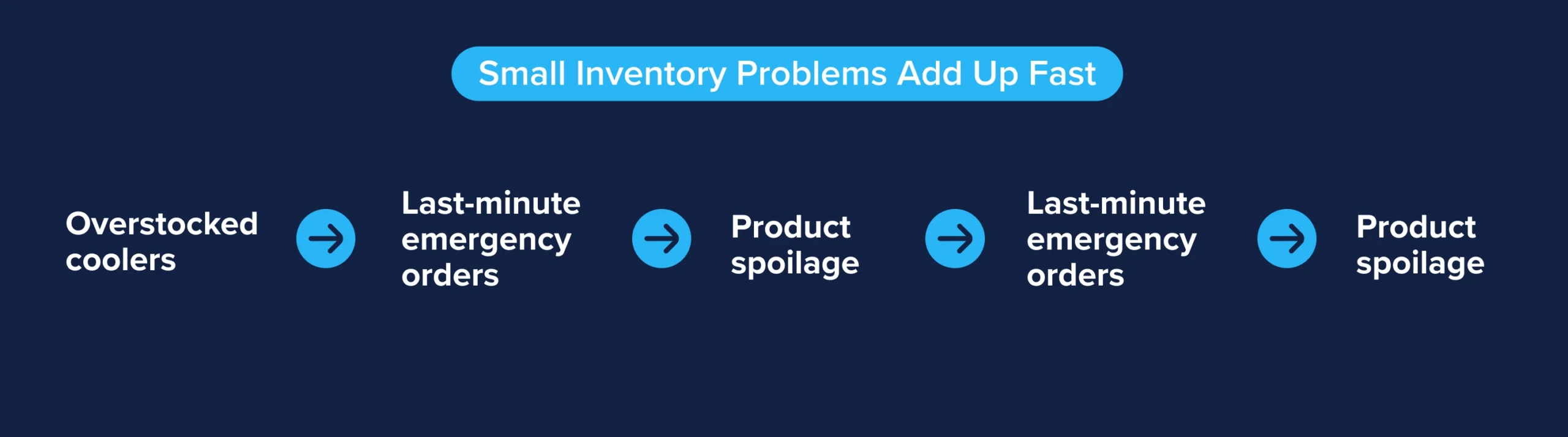
For example, poor inventory visibility can lead to:
- Overstocked coolers and freezers
- Product spoilage
- Duplicate ordering
- Missing inventory during peak periods
- Last-minute substitutions
- Higher emergency purchasing costs
- Inconsistent inventory usage between locations
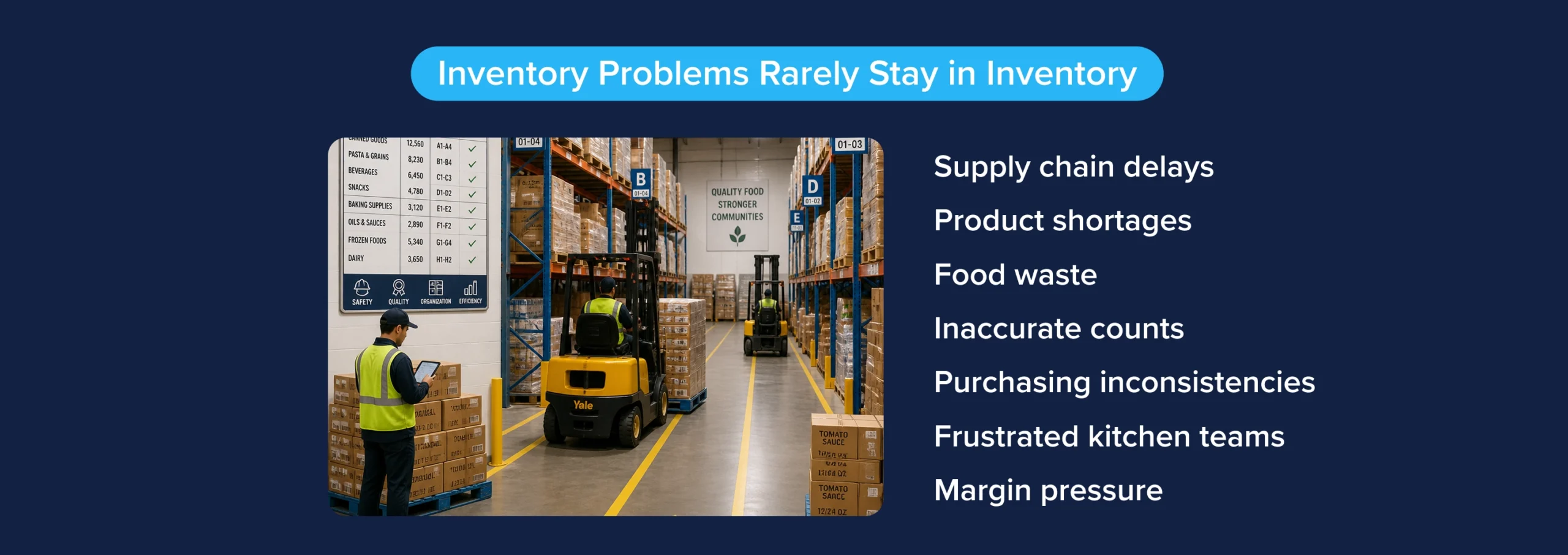
And honestly, inventory problems usually do not stay isolated to inventory for very long.
They eventually spill into other parts of the business too. Kitchen teams get frustrated. Ordering becomes reactive instead of planned. Storage areas become harder to manage. Food waste increases quietly over time.
That is why many operators are putting more focus on inventory visibility now than they did a few years ago.
The goal is not just keeping products on shelves. It is creating a more consistent, organized, and predictable operation overall.
Key Benefits of Effective Inventory Management
Reduced Food Waste
Food waste is one of the easiest ways for margins to quietly disappear.
Sometimes it is spoilage. Sometimes it is prep overproduction. Sometimes products simply get buried in storage and forgotten.
Operators using stronger food inventory management processes often improve waste control by:
- Rotating inventory more consistently
- Tracking expiration dates
- Monitoring slower-moving products
- Reducing duplicate ordering
- Improving inventory visibility between teams
One of the biggest problems in foodservice is that waste is not always obvious day to day. It usually shows up later in inventory variance reports and higher food costs.
Improved Cash Flow
Optimizing inventory levels also plays a crucial role in improving cash flow. Holding too much stock ties up capital that could be used for other critical operations, while understocking could lead to lost sales opportunities. By adopting a “just enough” inventory strategy—where stock levels are carefully managed to meet demand—restaurants can reduce storage costs and free up cash that would otherwise be tied to excess inventory. This allows businesses to reinvest in growth areas, such as marketing, technology, or staff training.
Improved Cost Control and Margins
Inventory affects almost every major cost category in foodservice.
When operators do not have a clear picture of what is being ordered, transferred, wasted, or overused, margins become harder to protect.
Better food inventory management can help operators:
- Reduce unnecessary purchases
- Improve ordering consistency
- Identify pricing issues faster
- Spot unusual usage trends
- Tighten inventory accountability
A lot of operators are realizing that margin pressure is not always coming from one massive cost increase. Sometimes it is operational leakage happening across dozens of smaller inventory decisions.
Better Demand Forecasting
Forecasting has gotten harder over the last few years.
Traffic patterns shift constantly. Weather affects sales. Catering volume changes week to week. Seasonal spikes hit differently than expected.
That makes inventory planning much more difficult.
Operators using inventory data more strategically are often better able to:
- Prepare for sales fluctuations
- Avoid product shortages
- Reduce overordering
- Improve labor planning
- Adjust purchasing based on real usage trends
The goal is not perfect forecasting. Most operators know that is unrealistic.
The goal is making smarter inventory decisions with better visibility.
Enhanced Food Safety and Compliance
Inventory management also affects food safety more than many teams realize.
Without proper tracking, operators can struggle with:
- Product rotation
- Expiration monitoring
- Recall management
- Traceability
- Storage compliance
- Lot tracking
This becomes even more important for large-scale foodservice operations managing inventory across multiple locations, suppliers, and distribution points.
The more visibility operators have into inventory movement, the easier food safety management becomes.
Top Food Inventory Management Techniques
There is no single “perfect” food inventory management strategy that works for every operation.
Most foodservice teams end up using a mix of different inventory habits depending on what they are ordering, how much storage space they have, and how quickly products move through the kitchen.
Some methods are super formal. Others are things kitchen teams already do naturally without realizing there is an actual name for it.
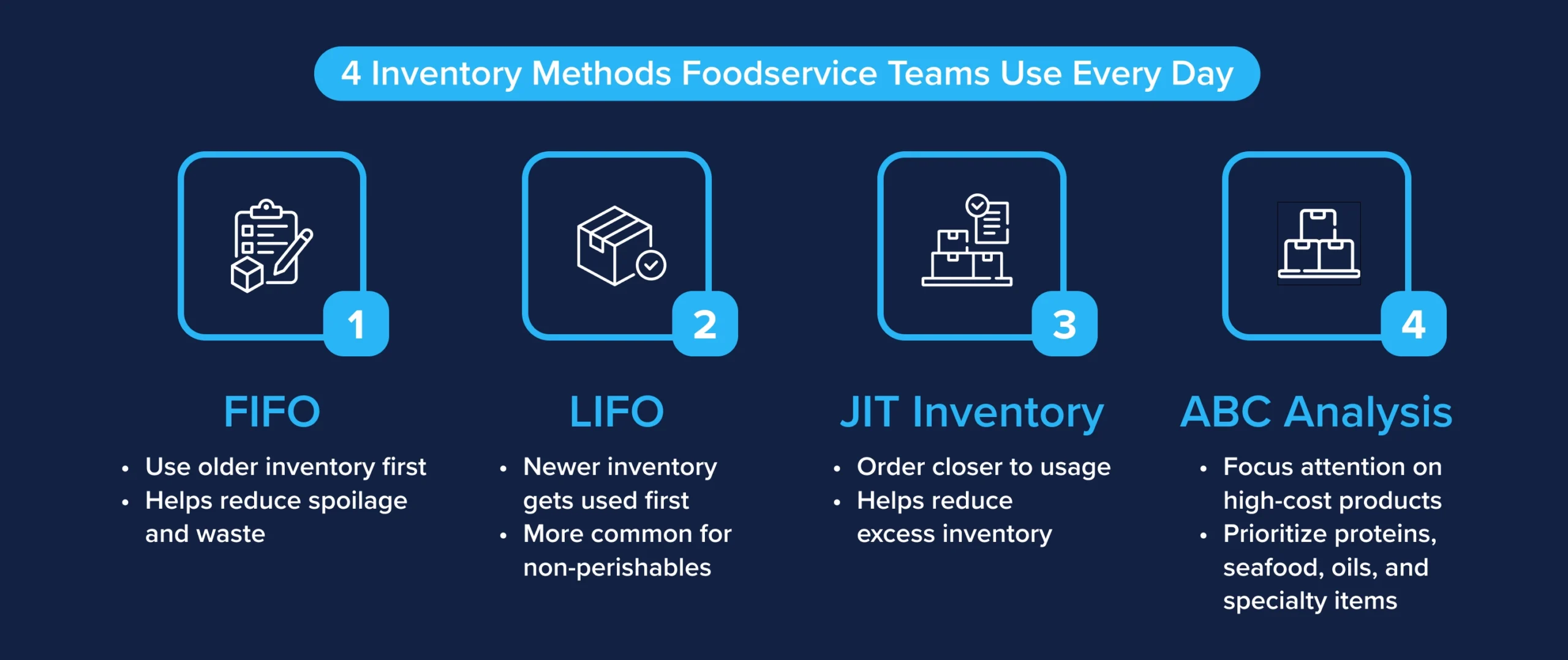
FIFO (First-In, First-Out)
FIFO is probably the inventory method most operators are already using in some way.
The concept is pretty straightforward: use the older product first.
So if a new produce truck comes in today, the cases already sitting in the cooler should get used before the brand-new shipment gets opened. Same goes for dairy, proteins, sauces, basically anything with a shelf life.
It sounds simple, but when kitchens get busy, it is easy for newer product to accidentally get pushed to the front while older inventory gets forgotten in the back corner of the walk-in.
That is usually where spoilage starts creeping in.
Operators like FIFO because it helps:
- Keep product fresher
- Reduce waste
- Lower spoilage risk
- Support better food safety habits
Honestly, most kitchen managers have been practicing FIFO for years without calling it FIFO.
LIFO (Last-In, Last-Out)
LIFO works the opposite way.
Instead of using the older inventory first, teams end up using the newest inventory first.
In foodservice, that can get risky pretty quickly with perishable products. If newer inventory keeps getting opened first, older product can sit too long and eventually expire before anyone realizes it.
That said, some operations still use a version of LIFO for:
- Certain dry storage products
- Paper goods
- Bulk non-perishable inventory
- Overflow storage situations
But for most foodservice operations, FIFO tends to make a lot more sense day to day.
Just-In-Time (JIT) Inventory
Just-In-Time inventory got really popular because operators wanted to avoid tying up money in excess inventory.
The basic idea is ordering products closer to when they are actually needed instead of loading up storage areas with extra stock “just in case.”
When it works well, JIT can help operators:
- Free up cooler and freezer space
- Reduce waste
- Improve cash flow
- Avoid sitting on excess inventory
But there is definitely a tradeoff.
The leaner your inventory gets, the less room there is for supply chain problems. One delayed truck or unexpected shortage can suddenly turn into a much bigger operational issue.
A lot of operators learned that the hard way over the last few years.
ABC Inventory Analysis
Not every product in the building needs the same level of attention.
If someone accidentally orders an extra case of napkins, most operators are probably not losing sleep over it. But if a location suddenly starts burning through extra steak, seafood, or frying oil every week without anybody noticing, that is where costs can get ugly fast.
That is basically the idea behind ABC inventory analysis. It helps operators separate the products that truly impact margins from the ones that are less critical day to day.
Most teams break inventory into three general buckets:
- A items are the expensive products operators watch closely
- B items are important but usually less financially risky
- C items are lower-cost products that tend to have less impact overall
In a lot of foodservice operations, A items are usually the categories that move the most money through the kitchen:
- Proteins
- Seafood
- Cooking oils
- Specialty ingredients
- High-volume menu products
These are the products operators usually monitor more carefully because even small inconsistencies can add up quickly across multiple shifts or locations.
For example, if one location is portioning proteins differently than another, food costs can quietly drift upward without anybody immediately realizing why. Same thing with oil usage, seafood waste, or high-cost prep items.
ABC inventory analysis helps teams spend more time paying attention to the products that have the biggest financial impact instead of treating every inventory item exactly the same.
Step-by-Step Food Inventory Management Process
Food inventory management does not need to feel like a massive overhaul from day one.
For most operators, the better approach is to clean up the basics first. Get a clearer picture of what is on hand, where the biggest inconsistencies are happening, and which items are causing the most waste or cost pressure.
Once that foundation is in place, the process gets a lot easier to manage.
Conduct an Inventory Audit
Start by getting honest about what is actually sitting in storage.
That means looking at the walk-ins, freezers, dry storage, prep areas, and any overflow spots where products tend to disappear until someone finds them three weeks later.
An inventory audit can help uncover:
- Products being overordered
- Items that are not moving quickly enough
- Expired or close-to-expiring products
- Gaps between what was ordered and what was used
- Storage issues that make counts harder than they need to be
It is not glamorous work, but neither is finding six forgotten cases of something nobody remembers ordering.
Categorize Inventory Items
Once the audit is done, organize products into categories that make sense for the operation.
Most teams group inventory by things like:
- Proteins
- Produce
- Dairy
- Frozen foods
- Dry goods
- Beverages
- Packaging and disposables
This makes inventory easier to count, track, and compare over time. It also helps operators spot which categories are creating the most pressure.
If proteins are driving food cost swings, that category deserves more attention. If packaging keeps getting overordered, that is worth tracking too.
Set Par Levels
Par levels give teams a clear target for how much product should be on hand.
Without them, ordering can get a little too emotional. One slow weekend, and suddenly nobody wants to order enough. One busy weekend, and the cooler gets packed like everyone is preparing for a snowstorm.
Par levels help operators avoid both extremes.
They should be based on:
- Average sales volume
- Menu mix
- Supplier lead times
- Storage space
- Seasonality
- Upcoming events or promotions
Par levels are not set-it-and-forget-it numbers. They need to change as the business changes.
Manage Suppliers and Orders
Inventory management gets a lot easier when supplier and order information is organized.
Operators should be able to see what was ordered, what arrived, what was substituted, and what pricing changed.
That visibility matters because a supplier issue can quickly turn into an inventory issue.
A late delivery can throw off prep. A substitution can affect menu consistency. A pricing change can hit margins before anyone catches it.
The more clearly teams can track orders and supplier performance, the easier it is to adjust before small issues become bigger problems.
Implement Inventory Tracking System
At some point, spreadsheets start to show their limits.
They can work for a while, but once an operation has multiple locations, more suppliers, and higher order volume, manual tracking becomes harder to trust.
An inventory tracking system can help teams:
- Keep inventory data in one place
- Reduce manual entry mistakes
- Compare usage across locations
- Track waste and variance
- See purchasing patterns more clearly
The point is not to add another system just for the sake of it. The point is to give operators better visibility without making teams chase numbers all day.
Track Inventory Data and Performance
Inventory data is only useful if teams actually look at it.
Operators should pay attention to patterns like:
- Which items are being wasted most often
- Which products are being overordered
- Where usage does not match sales
- Which locations are ordering differently
- Where supplier issues keep showing up
This is where food inventory management starts moving from basic counting to better decision-making.
The numbers can tell a story, but only if someone is reading it.
Perform Regular Stock Counts
Regular stock counts keep inventory from drifting too far off course.
Some items may need to be counted daily, especially high-cost or high-volume products. Others may only need weekly or monthly checks.
A practical counting rhythm might include:
- Daily checks for key proteins, seafood, or high-cost items
- Weekly cycle counts for core categories
- Monthly full inventory counts
- Extra counts before major seasonal shifts or high-volume events
The goal is not perfection. The goal is consistency.
When counts happen regularly, operators can catch problems earlier, make better ordering decisions, and avoid those “how are we already out of this?” moments nobody enjoys.
Implementing Safety Stock Levels
Forecasting is useful, but nothing in the food service industry is 100% certain. Safety stock acts as a buffer when:
- Sales go up out of the blue
- Deliveries are late
- Suppliers are having trouble making things
- There are problems with transportation
The goal isn’t to overstock, but to create margin for error on essential SKUs so units can continue operating without panic or improvisation.
Use Inventory Software to Automate Tracking and Add Visibility
Promote the full adoption of your foodservice inventory management software among all staff and partners to consolidate internal and external operations. This means that data on product spend, inventory levels, and more remain updated, accurate, and visible to all teams, ensuring a centralized data source of supply chain information that’s entered within the same software platform.
When foodservice organizations have all data within one single hub, software automation can verify data discrepancies and develop analytical insight based on all data sets.
All supply chain staff and partners can then consult a single source of data, offering an expansive view of company developments as well as a guided plan of action. Furthermore, intuitive dashboards conveniently showcase highly relevant data, making it easy for supply chain teams to develop actionable goals and initiatives.
Promoting that employees fully integrate their daily tasks with a centralized software system ensures the best return on investment and data control.
No matter your restaurant chain’s operational state or stage, ensuring all have access to transparent data within the supply chain allows operators to effectively prevent inventory risks, plus more.
Common Challenges in Food Inventory Management
Overstocking and Understocking
Finding the right inventory balance is difficult.
Too much inventory creates:
- Spoilage risk
- Storage pressure
- Higher carrying costs
Too little inventory creates:
- Product outages
- Emergency purchasing
- Menu disruptions
- Customer frustration
Most operators are constantly trying to balance both sides.
Food Spoilage and Waste
Spoilage remains one of the biggest hidden cost drivers in foodservice.
Products expire. Prep gets overproduced. Inventory gets buried in storage.
Without strong inventory visibility, waste becomes much harder to control consistently.
Inaccurate Inventory Tracking
Inventory accuracy issues are extremely common in foodservice.
Manual entry mistakes, delayed updates, and inconsistent counting procedures can all create inventory discrepancies.
And once inventory data becomes unreliable, forecasting and purchasing decisions become harder too.
Multi-Location Visibility Issues
Multi-unit operators often struggle with inconsistent inventory visibility between locations.
Different teams may:
- Count inventory differently
- Order differently
- Store products differently
- Follow different processes
That inconsistency can make it difficult to identify operational trends across the business.
Supply Chain Disruptions
Supply chain disruptions continue affecting inventory planning across foodservice.
Late deliveries, shortages, substitutions, and fluctuating availability all create inventory pressure.
Operations with stronger inventory visibility are usually able to react faster when disruptions happen.
Get Started with ArrowStream
Food inventory management is no longer just a back-of-house task.
For many foodservice operators, it has become one of the biggest factors affecting:
- Profitability
- Purchasing consistency
- Waste reduction
- Supply chain visibility
- Operational performance
The challenge is that inventory gets harder to manage as operations grow.
More locations. More suppliers. More purchasing complexity. More moving parts.
Ready to improve visibility into inventory, purchasing, and supply chain performance across your operation? Click here to contact ArrowStream today to see how smarter operational visibility can help your team make faster, more informed decisions.
FAQ’s
What is the best method for food inventory management?
Honestly, most kitchens are already using some version of FIFO whether they realize it or not. If a new case of produce comes in today, teams usually try to use the older product first before opening the new shipment. That alone can help cut down on spoilage pretty quickly. The “best” inventory method really depends on how the operation runs, what products move fastest, and how much storage space the team is working with.
What software is used for food inventory management?
A lot of operators start with spreadsheets, then eventually hit a point where manual tracking becomes too difficult to manage consistently. That is usually when inventory software starts making a bigger difference. Some systems focus heavily on inventory counts, while others tie together purchasing, supplier visibility, food costs, and supply chain tracking in one place. It really comes down to how much visibility the operation needs.
How can restaurants reduce food waste?
Most restaurants do not lose money from one huge waste issue. It is usually smaller things happening over and over again. Prep getting overproduced. Cases expiring in the walk-in. Duplicate ordering between shifts. Inventory getting buried in storage. Better tracking, more consistent rotation, and tighter visibility into usage trends can help operators catch those problems earlier before waste starts stacking up.
What are par levels in inventory management?
Par levels are basically inventory guardrails. They help teams know when it is time to reorder and how much product they should realistically keep on hand. Without them, some locations end up overordering “just to be safe,” while others run short during busy periods. Most operators adjust par levels constantly throughout the year depending on seasonality, traffic, and product availability.
How does inventory management work across multiple locations?
That is usually where inventory gets messy. One location orders aggressively, another keeps inventory lean, and suddenly reporting is all over the place. Multi-location inventory management works best when operators can actually compare purchasing, inventory counts, and usage trends across every store in one place. Otherwise, teams spend more time chasing inconsistencies than solving them.