

Forecasting food and beverage sales is critical to the foodservice supply chain. Manufacturers and suppliers must balance production capacity, inventory levels, pricing, and demand planning.
Accurate forecasting helps businesses respond more quickly to shifts in restaurant purchasing behavior while reducing waste, shortages, and costly surprises. From seasonal demand swings to changing consumer preferences, strong forecasting gives manufacturers a clearer picture of future demand.
What Is Food and Beverage Sales Forecasting?
Forecasting food and beverage sales estimates future demand based on historical performance, purchasing trends, market conditions, and external factors that influence buying behavior. In foodservice manufacturing, forecasting helps suppliers anticipate what restaurant chains, distributors, and operators are likely to purchase.
Accurate forecasting supports decisions across production, procurement, inventory management, transportation, and pricing strategy. It also helps manufacturers avoid overproducing or underestimating demand.
While forecasting restaurant sales is often associated with individual operators managing labor or inventory, manufacturers face similar challenges, but on a much larger scale. A sudden spike in demand for a menu category or regional product can quickly disrupt production schedules and supply planning if visibility is limited.
Forecasting in the food and beverage industry depends on timely data, not just historical averages.
Why Accurate Sales Forecasting Is Critical in the Food and Beverage Industry
Forecasting affects nearly every part of the foodservice supply chain. With a clearer understanding of future demand, manufacturers can make more informed operational and financial decisions.
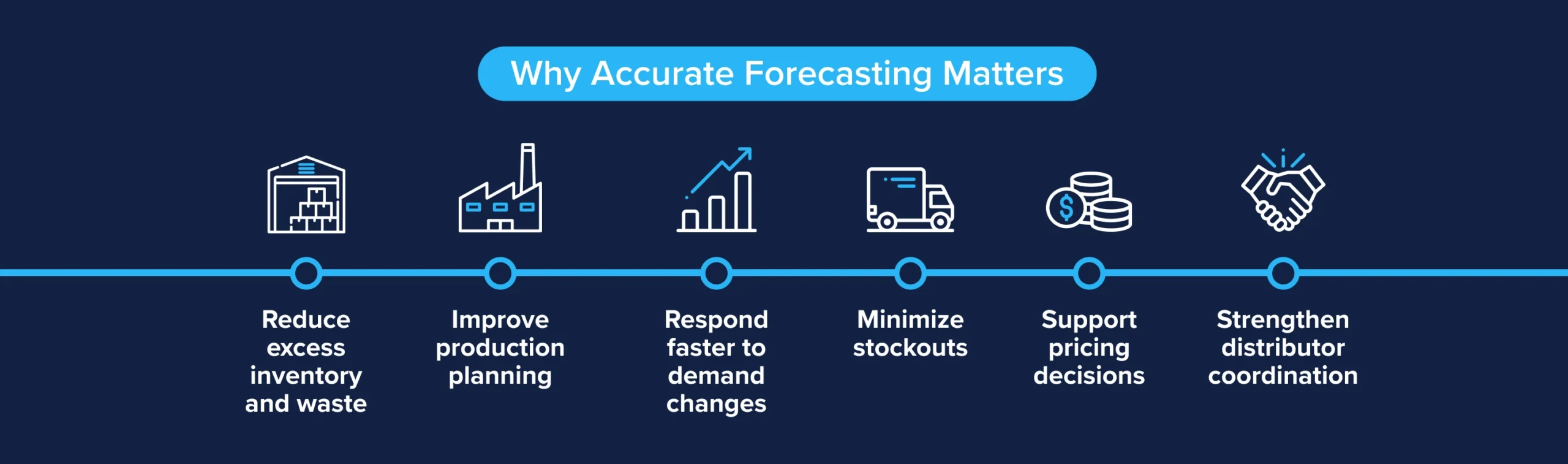
Strong forecasting helps businesses:
- Reduce excess inventory and product waste
- Improve production and purchasing efficiency
- Respond quicker to changes in restaurant demand
- Minimize stockouts and fulfillment disruptions
- Support more stable pricing and procurement decisions
- Improve coordination with distributors and restaurant chains
Forecasting restaurant sales also helps manufacturers align supply with purchasing behavior across different markets, regions, and customer segments.
Without accurate forecasting, even small demand shifts can create costly downstream challenges.
Key Factors That Influence Food and Beverage Sales Forecasts
Several factors influence forecasting accuracy in foodservice manufacturing.
Historical Sales Trends and Seasonality
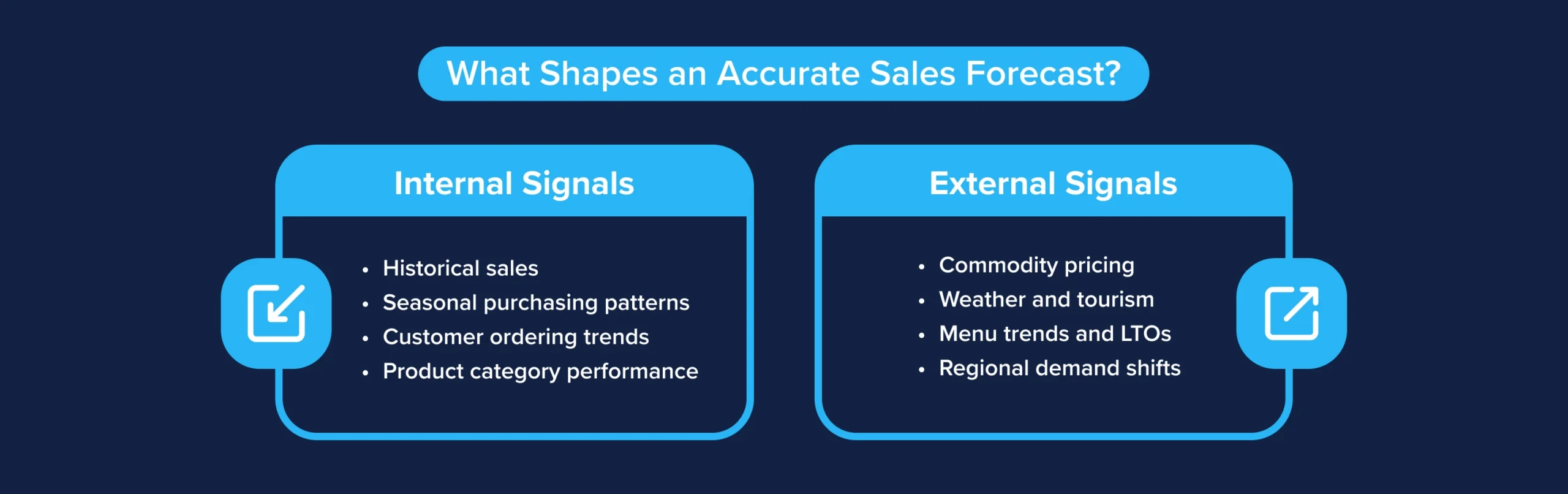
Historical purchasing data often provides the foundation for forecasting food and beverage sales. Seasonal demand patterns can significantly affect restaurant ordering behavior throughout the year. Sporting events, holidays, weather shifts, and tourism cycles all influence purchasing volume across different categories.
Manufacturers also need visibility into broader supply chain disruptions that may affect demand patterns or product availability.
Menu Changes and Product Demand Shifts
Trends, LTOs, and changing consumer preferences can all alter demand patterns. A growing interest in high-protein snacks, spicy flavors, premium beverages, or globally inspired menu items may create rapid purchasing increases across specific product categories.
Manufacturers that monitor evolving menu trends are often better positioned to adjust forecasts before demand spikes.
Market Conditions and Pricing Fluctuations
Inflation, commodity pricing, labor shortages, and transportation costs can all influence purchasing behavior across the foodservice industry. Restaurants may change menu pricing, reduce SKU counts, or shift suppliers in response to cost pressures.
These changes can affect order volume and product mix across multiple customer segments simultaneously.
External Events and Local Demand Variations
Local demand conditions can vary significantly across regions and restaurant chains. Tourism patterns, severe weather, regional events, and local economic conditions may all influence purchasing activity.
For manufacturers serving national restaurant brands, understanding localized demand shifts is often just as important as understanding national trends.
Common Methods Used to Forecast Food and Beverage Sales
Manufacturers use several forecasting approaches depending on the type of product, available data, and level of market visibility.
Moving Averages and Historical Comparisons
Moving averages rely on past sales performance to estimate future demand. This method helps smooth short-term fluctuations and identify broader purchasing patterns over time.
Historical comparisons are commonly used when demand remains stable across predictable periods.
Trend-Based and Seasonal Forecasting Models
Trend-based forecasting evaluates long-term growth or decline within product categories, customer segments, or geographic markets. Seasonal forecasting models build on historical demand cycles to anticipate recurring purchasing behavior throughout the year.
These models are especially useful for products tied to weather, holidays, or major sporting seasons.
Regression and Data-Driven Forecasting Approaches
Regression models analyze relationships between different variables that influence purchasing behavior. Pricing changes, promotional activity, consumer trends, and economic conditions may all be incorporated into these models.
Advanced forecasting in the food and beverage industry relies on integrated operational and sales data rather than spreadsheets from a single store.
Real-Time Forecasting Using Live Demand Signals
Real-time forecasting incorporates live purchasing activity and current market conditions into demand planning. Instead of relying solely on historical data, manufacturers can respond to emerging demand shifts as they happen.
This approach improves visibility into restaurant sales trends across restaurant chains, distributors, and regional markets.
How to Build an Accurate Food and Beverage Sales Forecast
Accurate forecasting requires more than historical sales reports. Manufacturers need a structured process that combines historical analysis with current demand visibility.
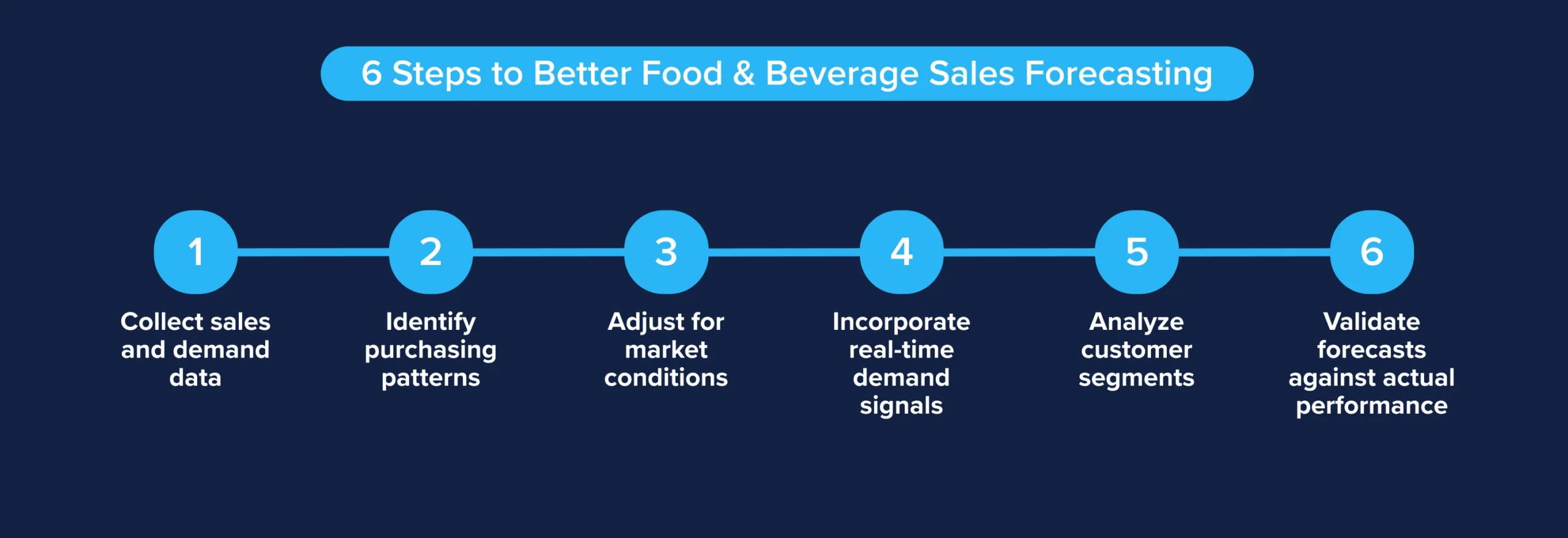
Collect and Structure Sales and Demand Data
Forecasting accuracy depends heavily on data quality. Manufacturers should centralize sales, purchasing, inventory, and customer demand data into a consistent format before building forecasts.
Disconnected systems and inconsistent reporting structures can create visibility gaps that reduce forecasting reliability.
Identify Patterns Across Time Periods and Product Categories
Once data is organized, manufacturers can begin identifying recurring purchasing patterns across customer groups, geographic markets, and product categories.
Analyzing demand over weekly, monthly, quarterly, and seasonal periods often reveals trends not visible in shorter reporting windows.
Adjust Forecasts for Seasonality, Pricing, and External Factors
Historical trends alone rarely tell the full story. Forecasts should also account for pricing changes, supply chain disruptions, weather events, inflationary pressures, and evolving consumer preferences.
Dynamic forecasting is critical during periods of market volatility.
Incorporate Real-Time Demand Signals into Forecasts
Real-time demand visibility helps manufacturers respond quicker to purchasing shifts across restaurant chains and distributors. Current order activity, category growth, and regional demand spikes provide valuable forecasting insights.
Real-time demand signals help businesses avoid relying too heavily on outdated assumptions.
Analyze Demand Patterns Across Restaurant Chains
Restaurant types often behave differently under the same market conditions. Quick-service chains, casual dining brands, fine dining concepts, and convenience stores may all experience unique demand trends.
Analyzing purchasing behavior across restaurant types improves forecasting precision at both the regional and national levels.
Validate Forecasts Against Actual Sales Performance
Forecasting is an ongoing process. Comparing projected demand against actual sales performance helps manufacturers identify forecasting gaps and improve accuracy.
Regular validation also helps businesses adapt quicker when purchasing patterns begin to change.
Common Challenges in Food and Beverage Sales Forecasting
Even strong forecasting models can face limitations when visibility is incomplete, or market conditions shift rapidly.
Inaccurate or Incomplete Historical Data
Forecasting models are only as reliable as the data supporting them. Missing sales records, inconsistent reporting practices, and disconnected systems can all reduce forecasting accuracy.
Poor data quality often creates operational blind spots that grow more expensive over time.
Demand Volatility Across Locations and Categories
Demand patterns can vary significantly across restaurant brands, geographic markets, and product categories. A demand increase in one region may not reflect purchasing behavior elsewhere.
Manufacturers that rely too heavily on broad national averages may overlook important local demand changes.
Lack of Real-Time Demand Visibility
Many manufacturers still rely on delayed reporting cycles or static spreadsheets when forecasting food and beverage sales. Without access to live purchasing signals, businesses may struggle to respond more quickly to changing demand conditions.
Limited visibility can make inventory and production planning reactive. Stronger visibility into operational data and purchasing behavior helps businesses respond faster across the supply chain.
Over-Reliance on Static Forecasting Models
Static forecasting models may work during stable market conditions but struggle during periods of disruption or rapid demand change. Manufacturers need forecasting systems that can adapt alongside changing market conditions.
Using Sales Forecasting to Capture Demand and Drive Revenue Growth
Accurate forecasting helps manufacturers move beyond reactive planning. With stronger visibility into purchasing behavior, businesses can align production, inventory, and supply chain operations with demand.
Forecasting restaurant sales trends across chains and regions also helps manufacturers identify growth opportunities sooner, improve customer responsiveness, and reduce operational inefficiencies.
Many manufacturers are turning to connected demand intelligence platforms to improve forecasting accuracy. Solutions like ArrowStream SalesStream help manufacturers analyze purchasing behavior across restaurant chains and distributors using real-time sales and demand insights.
FAQ’s
What is the most accurate way to forecast food and beverage sales?
The most accurate forecasts combine historical sales data with real-time demand signals, market trends, seasonality, and customer purchasing behavior. Manufacturers that continuously monitor restaurant purchasing activity can adjust forecasts faster than those relying solely on historical averages, improving production planning and reducing inventory risk.
What data should be used for sales forecasting?
Effective forecasting uses historical sales, customer order history, inventory levels, pricing trends, seasonal demand, market conditions, and real-time purchasing data. Combining multiple data sources provides a more complete picture of future demand and helps manufacturers make more informed production and supply chain decisions.
How often should forecasts be updated?
Sales forecasts should be reviewed regularly and updated whenever meaningful changes occur in customer demand, market conditions, or purchasing behavior. Many manufacturers refresh forecasts weekly or even daily when using real-time demand intelligence, allowing them to respond more quickly to changing market conditions.
What are the most common mistakes in sales forecasting?
Common forecasting mistakes include relying only on historical data, using outdated information, overlooking seasonality, ignoring regional demand differences, and failing to account for market disruptions. Limited visibility into current purchasing activity can also reduce forecast accuracy and lead to production or inventory imbalances.
How can real-time data improve forecast accuracy?
Real-time data gives manufacturers immediate visibility into changing purchasing patterns across restaurant chains, distributors, and markets. Instead of reacting after demand shifts occur, businesses can adjust production, inventory, and supply planning as trends emerge, resulting in more accurate forecasts and faster decisions. The same visibility can also help identify hidden revenue opportunities by revealing changes in customer purchasing behavior.