
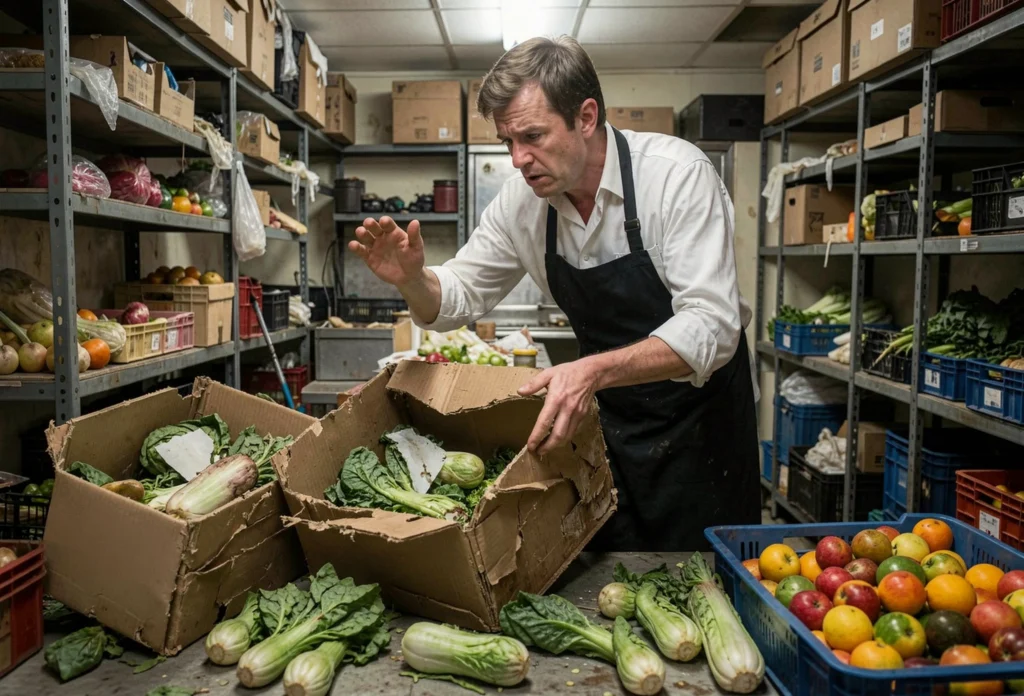
Food quality issues rarely start where they’re discovered.
A product may fail inspection at a distribution center, arrive at a restaurant outside specification, or trigger a customer complaint weeks after it was produced. By the time the issue surfaces, it has often passed through multiple suppliers, facilities, transportation providers, and distribution points.
That’s what makes food quality assurance so important.
Quality isn’t determined by a single inspection or food safety check. It’s built through a series of processes designed to verify that products meet expectations at every stage of the supply chain, from supplier qualification and raw material sourcing to production, distribution, and delivery.
When those processes are working effectively, organizations gain greater consistency, stronger supplier accountability, improved food safety, and better visibility into potential risks before they become larger operational problems.
As food supply chains become more interconnected and regulatory expectations continue to evolve, food quality assurance has become a critical part of managing risk, protecting brand reputation, and maintaining product consistency across the organization.
What Is Food Quality Assurance?
Food quality assurance is the process of ensuring products consistently meet established quality, safety, and specification requirements throughout the supply chain.
While food safety is a major component, quality assurance goes beyond preventing contamination or passing inspections. It’s about creating the controls, visibility, and accountability needed to deliver consistent products from supplier to end customer.
A typical food quality assurance program includes:
- Supplier qualification and performance monitoring
- Product specifications and quality standards
- Receiving and inspection procedures
- Process controls and food safety checks
- Traceability and recall readiness
- Documentation and recordkeeping
- Ongoing audits and continuous improvement efforts
Together, these processes help organizations identify risks earlier, reduce variability, and maintain greater consistency across suppliers, facilities, and locations.
For foodservice organizations, quality assurance extends well beyond a restaurant kitchen or distribution center. Products often move through multiple suppliers, production facilities, transportation providers, and warehouses before reaching their final destination. Effective quality assurance helps create visibility across each stage of that journey, making it easier to manage risk, maintain consistency, and respond quickly when issues arise.
Why Food Quality Assurance Matters
The consequences of poor quality can be expensive.
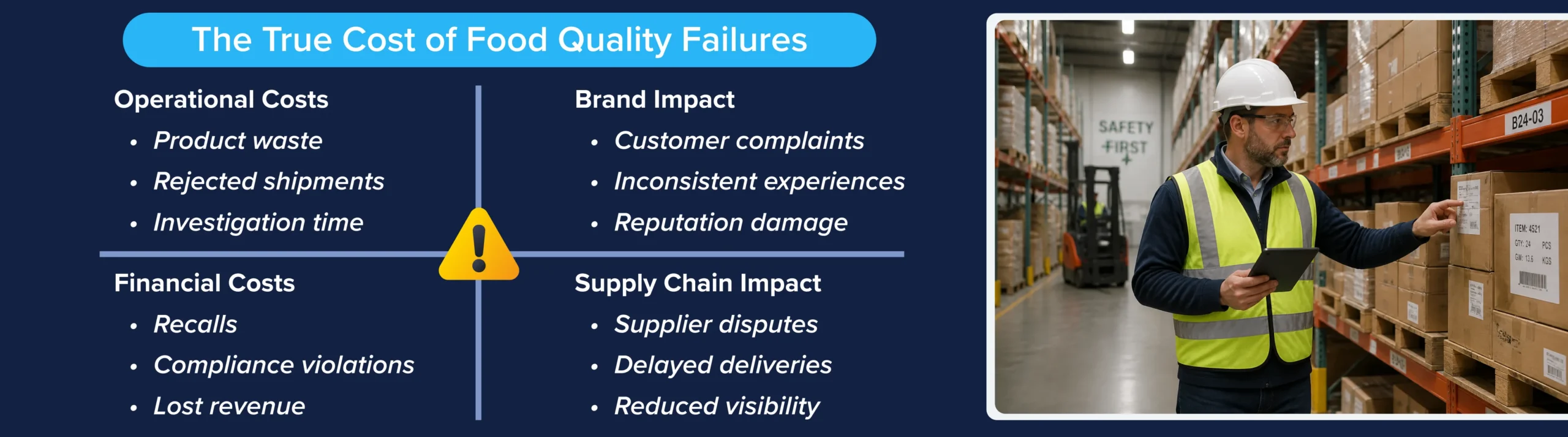
Some costs are easy to identify. Product waste, recalls, rejected shipments, and compliance violations can all create immediate financial impacts.
Other costs are harder to measure.
Customer trust can erode slowly after inconsistent experiences. Operators may lose confidence in suppliers. Teams spend valuable time investigating issues that could have been prevented.
Food quality assurance helps organizations:
- Protect brand reputation
- Improve food safety outcomes
- Reduce operational risk
- Strengthen supplier accountability
- Improve consistency across locations
- Support regulatory compliance
- Increase supply chain visibility
For organizations operating across multiple regions, maintaining consistency often becomes one of the biggest challenges. Customers expect the same quality experience regardless of location, and food quality assurance helps make that possible.
Food Quality Assurance vs Quality Control
People often use food quality assurance and quality control interchangeably, but they serve different purposes.
Quality assurance focuses on building systems that prevent problems from occurring.
Quality control focuses on identifying problems after products have already been produced or received.
A simple way to think about it:
Quality Assurance asks: How do we prevent issues?
Quality Control asks: Did an issue occur?
For example, creating supplier approval standards is quality assurance.
Inspecting incoming shipments for defects is quality control.
Both are important, but quality assurance creates the foundation that helps reduce quality failures before they reach customers.
Causes and Risks of Quality Incidents in Foodservice Supply Chain
To efficiently handle risks that affect food quality, it’s essential to first recognize the most common threats faced by foodservice operators and supply chain staff. Gaining this awareness is conducive to forming your company’s best quality risk management strategy.
There are two types of incidents to look out for: food-related and non-food-related. Though it may be seen as separate, often, non-food risks can become interrelated when quality issues arise.
Food-Related Risks to Watch Out for in Your Supply Chain
- Contamination caused by raw food
- Out-of-date products or packages that contain foreign objects
- Foodborne pathogens that can result in serious consumer illness
- Ingredients that are allergens (these must be stated on the packaging for consumer safety)
- Chemical residue from product preparation and processing
- Foreign facility risks that occur within a globalized supply chain
- Packaging defects or delivery damages
Non-food-related risks encompass service and logistics issues, so it’s crucial to have a proactive supply chain management strategy as a prevention method.
Non-Food Related Risks Within Your Supply Chain
- Late product and inventory deliveries
- Out-of-specification inventory that cannot be used
- Product shortages and substitution complications
- External inventory damage
- Inventory mispicks
- Risks that can occur from noncompliance during freight management
To give you an example of both of these risks, the cases below demonstrate how business decisions (or a lack of them) can impact your business and customers.
Non-Compliant Food Hygiene
A real-life case of a food-related risk that was not appropriately contained affected a meat supplier named Russell Hume, and the several catering businesses and pubs it supplied. Unfortunately, this list included the well-known chain of pubs throughout the UK called Wetherspoons.
During this foodservice scandal, FSA inspections confirmed a Russell Hume facility to be in severe non-compliance with food hygiene regulations. This caused Wetherspoons’ chain to temporarily remove various meat products from their menu, in addition to ending their contract with Russell Hume, which resulted in financial losses for both the chain and the supplier.
Critical Inventory Shortages
A financially costly case of a non-food-related risk was when KFC, a fast-food chain that centers its menu on chicken products, ran out of chicken due to gaining a new storage facility that was not easily accessible to staff.
These scenarios can be managed, and even sometimes avoided, with an organized and efficient quality control process and system. Choosing a system that offers management strategies regarding risk, incident, and crisis will ensure that you are prepared to competently offer quality and consumer safety.
Key Food Safety Regulations and Quality Standards
Food quality assurance programs don’t operate in a vacuum. They are heavily influenced by industry regulations and established quality frameworks.
U.S. Food and Drug Administration
The FDA plays a central role in regulating food safety throughout the United States.
The agency establishes requirements related to manufacturing practices, labeling, sanitation, food handling, and preventive controls.
For foodservice organizations, FDA regulations often serve as the baseline for building quality and food safety programs.
Food Safety Modernization Act
The Food Safety Modernization Act (FSMA) fundamentally changed how the industry approaches food safety.
Rather than focusing primarily on responding to contamination events, FSMA emphasizes prevention.
Organizations are expected to identify hazards, implement preventive controls, monitor effectiveness, and maintain detailed records demonstrating compliance.
The result is a much stronger connection between food safety, traceability, and food quality assurance.
HACCP Risk Management
Hazard Analysis and Critical Control Points (HACCP) provides a structured approach for identifying and controlling food safety risks.
Under HACCP, organizations evaluate where hazards could occur and establish controls to reduce those risks before they become problems.
Many quality assurance programs use HACCP principles as a foundation for food safety planning.
GMP (Good Manufacturing Practices)
Good Manufacturing Practices, often referred to as GMPs, establish expectations for how food products are produced and handled.
Areas commonly covered include:
- Employee hygiene
- Facility sanitation
- Equipment maintenance
- Pest control
- Storage procedures
- Production practices
Strong GMP programs create consistency and help support broader food quality assurance efforts.
Food Quality Assurance Process (Step-by-Step)
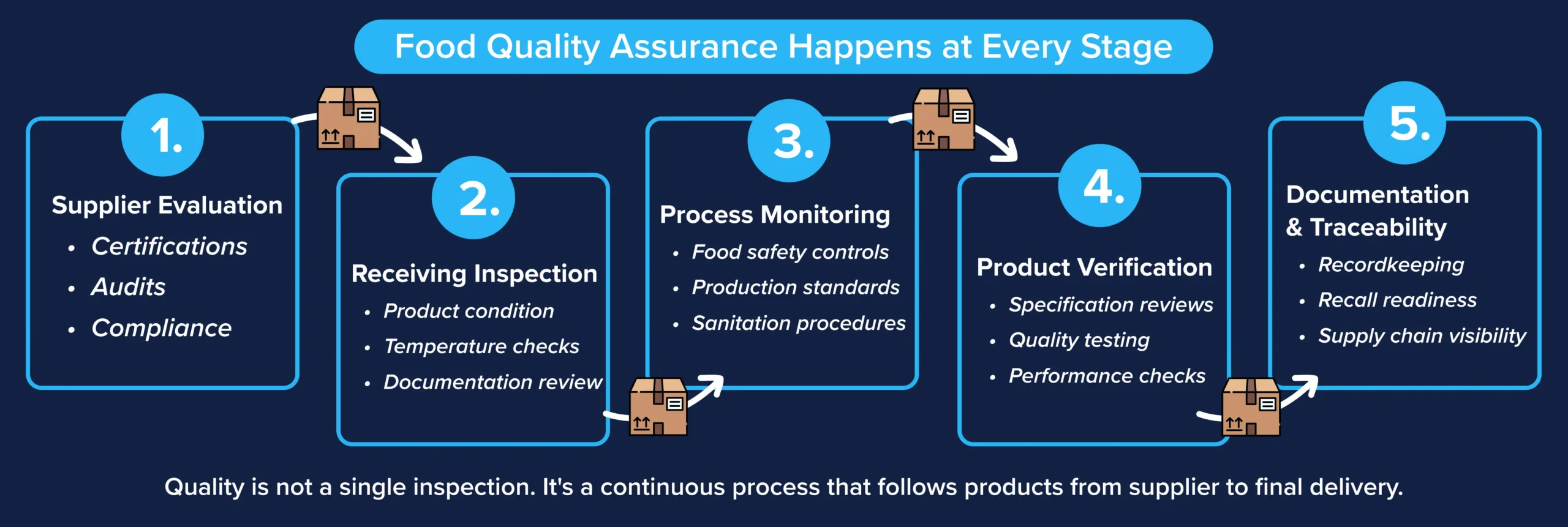
Quality doesn’t happen through a single inspection. It happens through a series of checkpoints throughout the supply chain.
Supplier Quality Evaluation
Quality begins long before a shipment arrives.
Organizations should carefully evaluate suppliers based on factors such as:
- Food safety certifications
- Audit performance
- Traceability capabilities
- Quality history
- Regulatory compliance records
A supplier that consistently delivers quality products can reduce risk throughout the entire operation.
Raw Material Inspection
Receiving teams serve as an important first line of defense.
Before products enter inventory or production, they should be evaluated for compliance with established specifications.
Common checks include:
- Product condition
- Packaging integrity
- Temperature requirements
- Label accuracy
- Documentation review
Catching issues early prevents larger problems downstream.
Process Monitoring and Control
Even high-quality ingredients can become quality issues if processes aren’t properly controlled.
Organizations often monitor:
- Temperatures
- Cooking procedures
- Holding times
- Allergen controls
- Sanitation practices
Consistent monitoring helps identify trends before they become significant issues.
Finished Product Testing
Before products move further through the supply chain, organizations often verify that quality standards have been met.
Depending on the product, testing may include:
- Sensory evaluations
- Microbiological testing
- Weight verification
- Specification reviews
- Shelf-life assessments
These checks provide an additional layer of confidence.
Documentation and Record Keeping
Documentation may not be the most exciting part of food quality assurance, but it is one of the most important.
Good records help organizations:
- Demonstrate compliance
- Support audits
- Improve traceability
- Investigate issues
- Manage recalls more effectively
Without proper documentation, even strong quality programs can struggle during an investigation or compliance review.
Key Challenges in Food Quality Assurance
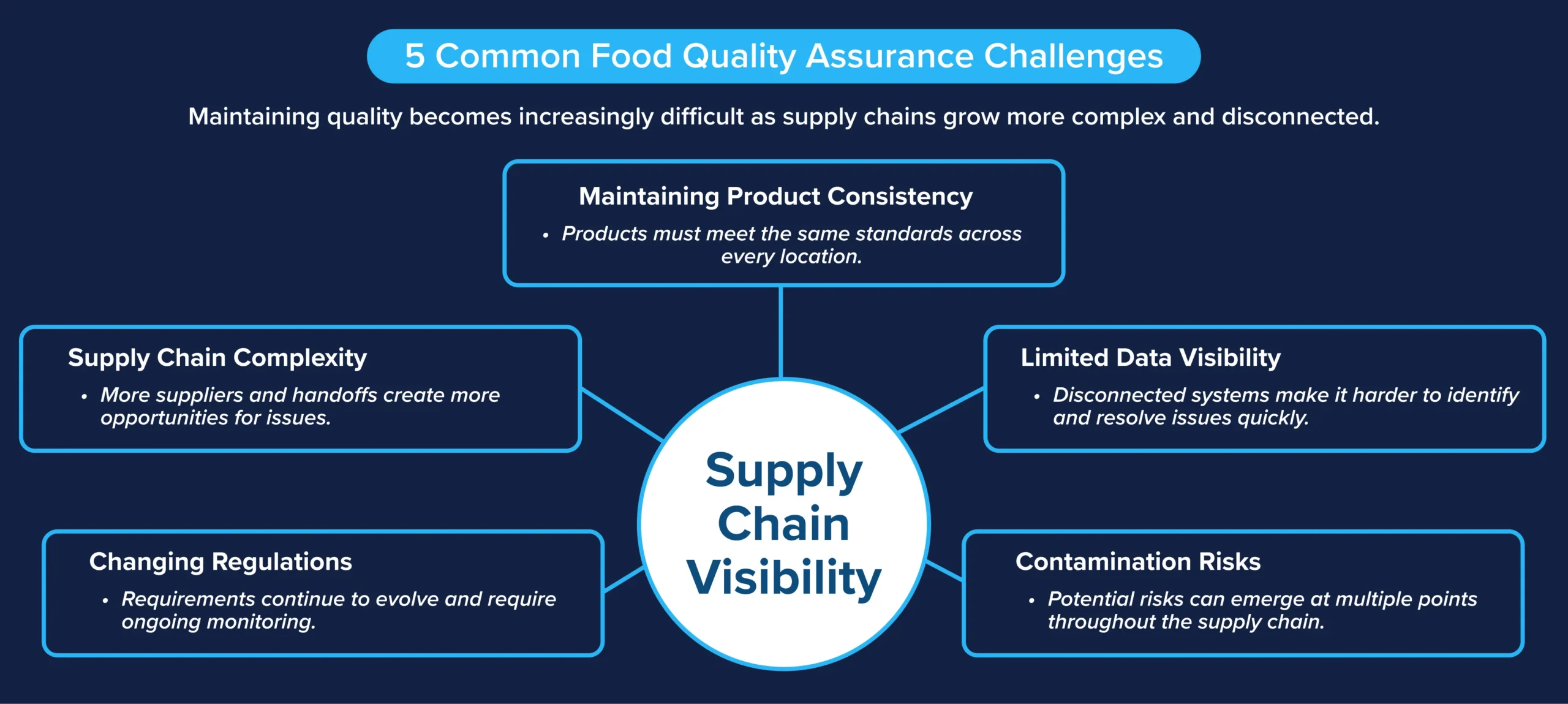
Maintaining Product Consistency
Consistency sounds simple until you are sourcing products from multiple suppliers and distributing them across numerous locations.
Even small variations in ingredients, production methods, or handling practices can create noticeable differences in quality.
Supply Chain Complexity
Food supply chains have become increasingly interconnected.
Products often move through multiple suppliers, processors, transportation providers, warehouses, and distribution centers before reaching their destination.
Every handoff introduces potential risk.
Regulatory Compliance Changes
Food safety regulations continue to evolve.
Organizations must stay informed, update procedures, train employees, and adjust quality programs as new requirements emerge.
Food Contamination Risks
Contamination risks can occur at nearly every point in the supply chain.
Whether biological, chemical, or physical, contamination events can have serious operational and reputational consequences.
Lack of Real-Time Data Visibility
Many organizations still manage quality data across spreadsheets, emails, and disconnected systems.
When information is difficult to access, it becomes harder to identify trends, investigate issues, and respond quickly.
This is where greater visibility can make a significant difference.
Managing a Food Quality Recall
Finding yourself in this position can be frightening and overwhelming, and you may not know where to start to resolve the issue. ArrowStream’s 20 years in the foodservice industry has helped to develop a tried-and-tested internal process that our customers utilize regularly, no matter the level of impact.
While using a quality management technology solution such as ArrowStream improves reaction time, communication and collaboration across stores and supply chain partners. This article will address those manual steps necessary for those corporate teams without such technologies.
When a recall occurs, the following internal steps are best practices to adopt:
1. Communicate with Your Stores
Whether or not you use a quality management supply chain technology, corporate procurement and quality assurance teams should notify all stores of the recall or issue as soon as possible.
A quick way to do this is to use email and BCC the necessary contacts (having an email list ready would increase the rate at which you can communicate). Depending on the issue at hand, you’ll want to include details such as the lot code, which supplier the product originated from, and the severity of the impact.
By addressing the incident proactively and hearing about this from corporate foodservice supply chain teams, you can manage the situation in real-time and spring into action quicker.
2. Document Quality Incident Details and Provide Direction
If your corporate foodservice supply chain team uses quality incident management systems, ensure that your corporate team gathers the following details about the product recall:
- The distribution centers (DCs) that have the product in-house
- The stores that received a delivery of the product
- The date the product was delivered to each store
- The quantity of cases each store has on-hand
- Pictures of the product in the stores
- Invoice numbers
- Lot codes
- Additional related information
After obtaining all the details from each store, the corporate supply chain team should provide direction to the stores on what to do with the recalled product, from destroying it and providing proof, or holding it to the side to be returned to the DC.
Additionally, it’s essential to facilitate the recall with the DCs and suppliers and provide them all the details sent from the stores.
If you’re using the ArrowStream platform to manage product recalls, you can save significant time during this step. After asking the stores to enter the issue into the system to account for all the products, ArrowStream’s platform will guide the store user through the input process and collect all necessary information.
Store users are also able to categorize issue types, which helps prioritize and flag more critical issues after it’s automatically sent to the responsible supply chain partners and provides more thorough reporting for analysis.
In a recall instance, ArrowStream users should select Recall as the issue type. The corporate team would then just need to ensure they provide direction on what the stores should do with the recalled product.
3. Communicate and Resolve the Issue with Supply Chain Partners
Once the stores have submitted the product’s required details into ArrowStream, a workflow will automatically kick off to notify the responsible suppliers and distributors.
The automatic workflow consists of informing partners, ensuring they receive all the product and recall details, documenting responses and communication in one place, concluding accountability and tracking resolution in terms of a financial credit and or product replacement.
For corporate teams not using quality management technology, you should identify the location of the product at both the DCs and stores, work with and ensure each store submitted the necessary details of the recalled product, work with the DCs and stores to destroy or return the product, and track credits and new shipments to the stores to replace the recalled product.
Best Practices for Effective Food Quality Assurance
Implement Standard Operating Procedures (SOPs)
Clear procedures help create consistency.
Employees should understand exactly how tasks should be performed and what standards must be met.
Conduct Regular Supplier Audits
Supplier performance should never be treated as a one-time evaluation.
Regular reviews help identify concerns early and strengthen supplier accountability.
Train Employees on Food Safety Standards
Even the strongest systems depend on people.
Ongoing training helps employees recognize risks and consistently follow established procedures.
Maintain End-to-End Traceability
The faster organizations can trace products through the supply chain, the faster they can respond when issues occur.
Traceability has become a critical component of modern food quality assurance programs.
Use Data for Continuous Improvement
Quality programs generate valuable information.
The most successful organizations use that information to identify trends, improve processes, strengthen supplier relationships, and reduce future risk.
Final Thoughts
Food quality assurance isn’t just about checking boxes for compliance. It’s about creating confidence throughout the supply chain.
When suppliers consistently meet specifications, products arrive as expected, and teams can quickly access the information they need, quality becomes much easier to maintain. The challenge is that today’s food supply chains are more complex than ever. Products move through multiple suppliers, facilities, distributors, and locations before reaching the end customer, creating more opportunities for quality issues to slip through the cracks.
That’s why visibility matters.
The organizations that do quality assurance well aren’t simply reacting to problems after they happen. They’re using data, traceability, supplier oversight, and standardized processes to identify risks earlier and make more informed decisions.
As food safety requirements evolve and supply chains become increasingly interconnected, having a clear view of product movement, supplier performance, and quality data can make the difference between quickly resolving an issue and scrambling to contain one.
Looking to strengthen food quality assurance, improve traceability, and gain greater visibility across your supply chain? ArrowStream helps foodservice organizations turn complex supply chain data into actionable insights that support quality, compliance, and operational performance.
FAQs
Who Is Responsible for Food Quality Assurance?
Food quality assurance isn’t owned by just one department.
Quality teams often lead the program, but procurement, suppliers, distributors, warehouse teams, operations leaders, and frontline employees all play a role. A supplier can have excellent quality standards, but if products aren’t handled properly during transportation, storage, or distribution, quality can still suffer.
The most effective QA programs create accountability across the entire supply chain, not just within a single team.
What Are the Key Components of a QA System?
A strong food quality assurance program is built around visibility, consistency, and risk prevention.
That typically includes supplier qualification, product specifications, receiving inspections, process monitoring, traceability, documentation, employee training, and ongoing performance reviews. Together, these processes help organizations identify potential issues earlier and maintain more consistent product quality across locations.
How Does QA Improve Food Safety?
Food quality assurance helps organizations move from reacting to problems to preventing them.
Instead of waiting for a customer complaint, failed inspection, or recall, QA programs establish controls throughout the supply chain to reduce risk before issues occur. This might include supplier audits, temperature monitoring, ingredient verification, or preventive food safety procedures designed to catch problems early.
What Is Traceability in Food Quality Assurance?
Traceability is the ability to track products as they move through the supply chain.
If a quality concern, recall, or supplier issue occurs, traceability helps organizations quickly identify where a product came from, where it was shipped, and which locations may be affected. The faster teams can access that information, the faster they can investigate issues and take corrective action.
What Is the Role of HACCP in QA?
HACCP helps organizations identify where food safety risks are most likely to occur and establish controls to manage those risks.
Rather than relying solely on end-product inspections, HACCP focuses on preventing issues during production, handling, storage, and distribution. That’s why HACCP principles are often considered a foundational component of modern food quality assurance programs.
How Can Technology Improve Food Quality Assurance?
Many organizations still manage quality information across spreadsheets, emails, supplier portals, and disconnected systems.
Technology helps bring that information together, making it easier to monitor supplier performance, track product movement, maintain traceability, and identify quality trends. Better visibility allows teams to investigate issues faster, make more informed decisions, and proactively address risks before they impact operations.