Food doesn’t move itself.
Behind every on-time delivery is a series of decisions: forecasting, routing, scheduling, inventory alignment, and constant adjustment.
When those decisions are disconnected, delivery becomes reactive. Costs climb. Service levels slip. Drivers idle. Customers notice.
That’s why food delivery optimization matters.
It’s not just about getting a truck from point A to point B. It’s about building a delivery system that is efficient, predictable, and resilient under pressure.
What is Food Delivery Optimization?
Let’s simplify this.
Food delivery optimization is really about making deliveries work better — with fewer surprises, fewer wasted miles, and fewer “why did this go wrong?” moments.
It’s the behind-the-scenes coordination that determines whether trucks leave on time, drivers stay productive, and customers get what they ordered when they expect it.
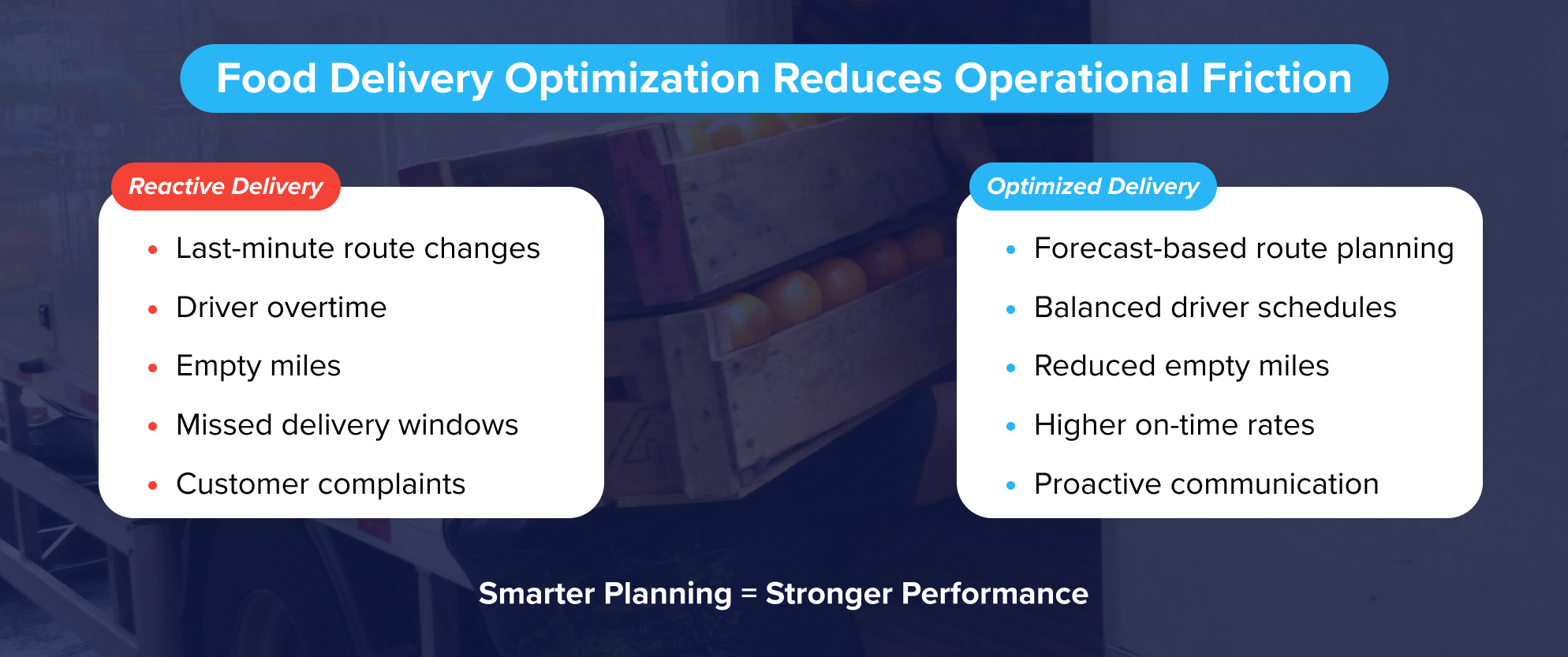
In practical terms, food delivery optimization touches things like:
- How accurately you predict order volume
- How you build and adjust routes
- How drivers are scheduled
- Whether the inventory is actually ready when the truck backs up to the dock
- And how quickly you know when something goes off track
Most teams are trying to balance two things at once:
Keeping costs under control
Meeting strict service expectations
And those two don’t always get along.
When food delivery optimization is working the way it should, you’ll notice it in small but meaningful ways: fewer empty miles, less driver overtime, better on-time percentages, and fewer reactive fire drills during the day.
Core Challenges in Food Delivery Operations
If delivery were just about moving freight, it would be simpler.
But food delivery isn’t standard freight. It’s perishable. It’s time-sensitive. And most of the time, the customer has a very specific window they expect you to hit.
That’s where things get complicated.

Fluctuating Order Volumes and Demand Variability
Order volume almost never stays steady.
One week is calm. The next week, a regional event, a promotion, or even weather shifts demand dramatically.
If food delivery optimization isn’t tied closely to demand forecasting, those swings show up in the worst ways — rushed route changes, overtime spikes, and stressed drivers.
Planning for variability isn’t optional. It’s part of the job.
Traffic Congestion and Route Disruptions
No route survives contact with real traffic.
Construction zones, accidents, urban congestion — they’re everyday realities.
A single delay early in a route can domino into missed delivery windows later in the day. That’s why food delivery optimization can’t rely on static route maps built months ago.
Routes need flexibility. Teams need visibility. And adjustments need to happen in real time.
Managing Perishable and Temperature-Sensitive Goods
Food has no tolerance for delay.
If frozen product thaws or fresh items sit too long on a dock, it’s not just inconvenient — it’s waste, claims, and potential compliance issues.
Food delivery optimization has to account for:
- Travel time
- Load sequencing
- Compartment temperature control
- Stop order planning
Because when product integrity slips, service reputation follows.
Multi-Channel Delivery Complexity
Most distributors aren’t serving just one type of customer anymore.
You might be delivering to:
- Independent restaurants
- Healthcare facilities
- Retail chains
- Schools
Each of those customers has different delivery windows, compliance needs, and service expectations.
Food delivery optimization becomes more layered as channels expand. What works for one segment may not work for another.
Compliance, Safety, and Service-Level Requirements
There’s also the regulatory side.
Food safety standards. Contractual service levels. Temperature documentation.
Late deliveries aren’t just frustrating — sometimes they’re financial penalties.
That’s another reason food delivery optimization isn’t just about saving fuel. It’s about reducing operational risk.
Essential Components of Food Delivery Optimization
Optimization doesn’t come from one tool or one change. It’s a collection of decisions that work together.

Demand Forecasting and Order Volume Planning
If forecasting is off, everything downstream feels it.
Routes get overbuilt or underbuilt. Drivers are either waiting around or scrambling.
Food delivery optimization improves dramatically when teams use historical data — real order patterns — instead of guessing based on last week’s volume.
Route Planning and Last-Mile Optimization
The last mile is where cost adds up fastest.
Small inefficiencies compound quickly:
- Extra miles between stops
- Poor stop sequencing
- Unbalanced routes
Strong food delivery optimization focuses heavily on tightening that last mile without sacrificing service windows.
Order Batching and Load Consolidation
Sending trucks that are half full might feel safe operationally, but it’s expensive.
Smart batching allows distributors to group compatible deliveries while still meeting commitments.
This is one of the most practical levers in food delivery optimization because it directly affects cost per stop.
Driver Scheduling and Workforce Optimization
Driver schedules should reflect reality, not tradition.
If volume patterns shift and schedules don’t, labor costs climb.
Food delivery optimization means aligning driver availability with actual demand — especially during seasonal swings.
Real-Time Visibility and Delivery Tracking
When there’s no visibility, teams are always reacting late.
Real-time tracking changes that dynamic.
Dispatch can see delays early. Customers can be notified before they call. Adjustments can happen mid-route.
Food delivery optimization depends heavily on that kind of transparency.
Inventory Alignment With Delivery Schedules
If inventory isn’t staged and ready when routes begin, delivery plans fall apart.
Procurement, warehouse operations, and delivery planning need to stay connected.
Food delivery optimization works best when inventory planning and route planning aren’t operating in separate conversations.
Role of Data and Analytics in Food Delivery Optimization
Data is what separates “we think this is working” from “we know this is working.”
Using Historical Data to Anticipate Demand Patterns
Patterns exist — even in volatile markets.
Looking at historical order cycles can reveal:
- Which days spike
- Which routes consistently run long
- Where seasonal shifts show up
Food delivery optimization becomes far more stable when planning is built around those insights.
Identifying Delivery Inefficiencies and Cost Drivers
Sometimes the biggest cost drivers aren’t obvious.
Analytics can uncover things like:
- Consistent idle time between stops
- Routes that generate excessive overtime
- Trucks that rarely reach full utilization
Once visible, these inefficiencies can actually be addressed.
Measuring On-Time Performance and Service Levels
On-time performance isn’t just a number on a report.
It reflects planning accuracy, route design, and operational discipline.
Food delivery optimization improves when on-time metrics are reviewed regularly, not just when complaints surface.
Continuous Improvement Through Performance Insights
Optimization isn’t a one-and-done project.
Markets shift. Customer expectations evolve.
Teams that review performance consistently and adjust accordingly are the ones who see sustained improvement in food delivery optimization.
Best Practices for Optimizing Food Delivery Operations
Some improvements are operational discipline, not technology
Standardizing Delivery Windows and Order Cut-Offs
Clear order cut-offs create cleaner forecasts.
Defined delivery windows reduce routing complexity.
Small structure changes often have an outsized impact on food delivery optimization.
Improving Communication Across Teams and Partners
Warehouse, dispatch, drivers, and customers need shared visibility.
Breakdowns usually happen at the handoffs.
Food delivery optimization improves when information flows consistently across those groups.
Reducing Idle Time and Empty Miles
Idle time is expensive but easy to overlook.
Route audits and driver performance tracking can expose patterns that quietly inflate cost.
Aligning Inventory, Procurement, and Distribution Planning
When procurement decisions don’t align with delivery schedules, disruptions increase.
Food delivery optimization requires those functions to operate as part of one system.
Preparing for Disruptions and Demand Spikes
Disruptions aren’t rare anymore; they’re expected.
Weather, supply shortages, sudden demand spikes — all of it requires contingency planning.
Flexibility is part of effective food delivery optimization.
Measuring Success in Food Delivery Optimization
Improvement needs proof.

Teams often track:
- On-time delivery rate
- Cost per delivery
- Miles per stop
- Driver productivity
- Fill rate accuracy
If those indicators trend in the right direction consistently, food delivery optimization efforts are delivering real results.
Common Mistakes to Avoid
These patterns can happen to even the best teams.
Treating Delivery as a Standalone Function
Delivery doesn’t happen on its own.
When procurement, warehousing, and routing work separately, they become less efficient.
Over-Reliance on Manual Planning
Spreadsheets and whiteboards work, but only until the number of items grows.
Manual systems make it hard to grow and make decisions quickly.
Ignoring Demand Volatility and Seasonality
It’s risky to think that next month will be like last month.
When planning models include volatility, food delivery optimization works best.
Lack of Visibility Into End-to-End Performance
Blind spots stay if you can’t see how well things are going from placing an order to getting it delivered.
Visibility is very important.
Final Thoughts
Food delivery optimization isn’t about perfection.
It’s about reducing friction.
It’s about building a delivery network that can absorb variability without losing control of cost or service.
When forecasting is tighter, routes are smarter, drivers are aligned with demand, and performance is reviewed consistently, delivery shifts from being a constant pressure point to a competitive strength.
And in today’s environment, that strength matters.
Food Delivery Optimization FAQs
How does demand forecasting improve delivery performance?
When you know what’s coming, you plan better.
Accurate forecasting helps build smarter routes, schedule the right number of drivers, and stage inventory correctly. Fewer surprises mean fewer delays and better on-time performance overall.
What causes inefficiencies in last-mile food delivery?
Usually, it’s small things adding up.
Poor route sequencing, traffic delays, underfilled trucks, or drivers waiting on product can all drive up costs. Last-mile issues tend to compound quickly, which is why they’re central to food delivery optimization.
How can distributors reduce delivery costs without hurting service?
By removing waste, not cutting corners.
Tighter routes, better load consolidation, smarter scheduling, and real-time visibility all lower costs while protecting service levels. Efficiency should improve performance, not reduce it.
What metrics should be tracked for delivery optimization?
Focus on what reflects both cost and service:
- On-time delivery rate
- Cost per stop
- Miles per route
- Driver productivity
- Fill rate accuracy
Tracking these consistently keeps food delivery optimization grounded in real performance.