
The foodservice supply chain has always been complex. Ingredients move fast, margins stay tight, and a single disruption can ripple across multiple locations in a matter of hours. What’s changed in recent years isn’t just demand volatility or labor pressure—it’s the sheer volume of data operators are expected to manage while making decisions in real time.
That’s where AI in food supply chain is starting to play a meaningful role. Not as a replacement for experience or relationships, but as a way to bring clarity to an environment that rarely slows down.
Impact of AI in the Food Supply Chain
In foodservice, supply chain decisions have never been made in a vacuum. Planning, sourcing, logistics, and quality all influence one another, but historically they’ve lived in different systems and reports. AI changes that dynamic by pulling those signals together and showing how one decision affects the next, often before the impact is felt on the floor or in the field.
The results aren’t theoretical. Forecasts become more reliable. Last-minute buys happen less often. Waste is easier to spot and address. When something shifts — demand, supply, transportation — teams see it sooner and have more time to respond. For organizations managing multiple suppliers or locations, that connected view replaces the patchwork of spreadsheets and manual checks that used to slow everything down.
Why the Traditional Food Supply Chain Struggles with Modern Demand
For years, the foodservice supply chain worked because conditions were relatively stable. Menus changed slowly, demand followed familiar patterns, and planning cycles allowed manual forecasting to keep pace.
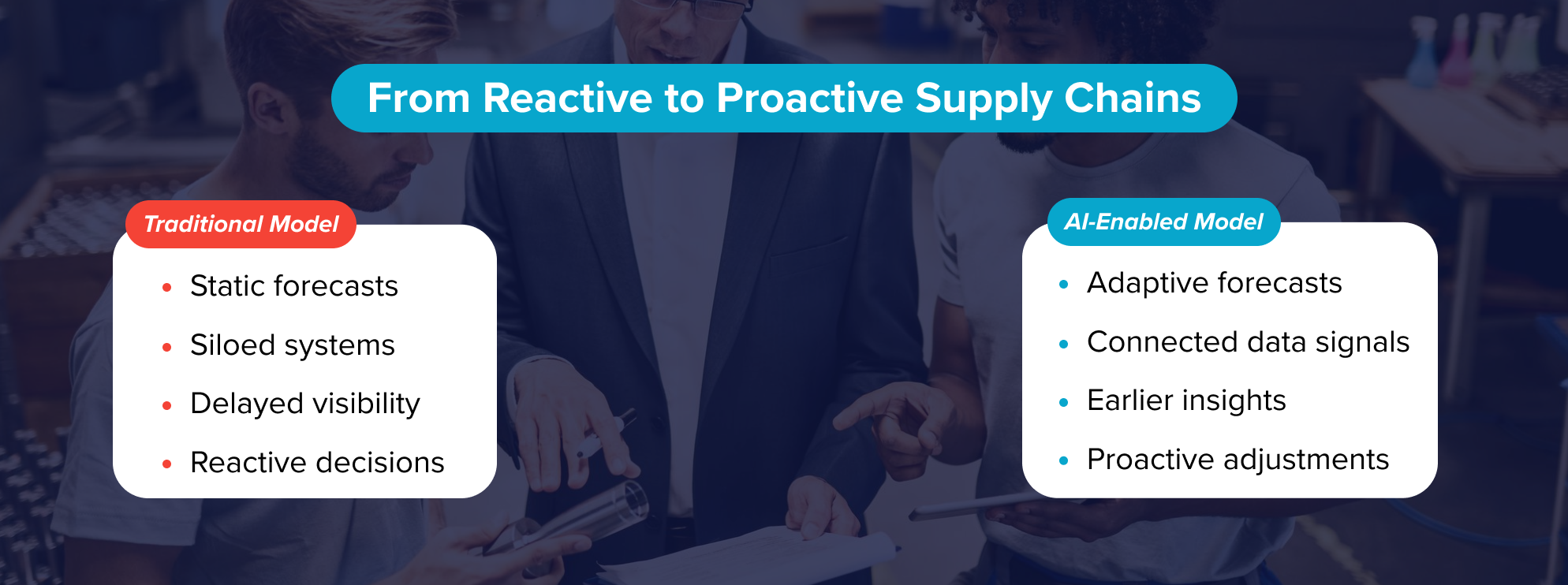
That stability is gone. Menus turn faster, promotions drive sudden demand shifts, and disruptions from weather, labor, and transportation are now routine. When decisions rely on static or backward-looking data, teams are left reacting after problems surface—often at a higher cost.
How AI Is Reshaping Foodservice Supply Chain Operations
Ask anyone who’s worked in foodservice long enough and they’ll tell you the same thing: most supply chain issues don’t announce themselves. They creep in. One off forecast turns into a rushed order. A late delivery throws off prep. Suddenly a small miss is costing real money.
What’s changing isn’t the pressure — it’s how early teams can see trouble coming.
Instead of waiting for reports to confirm what already went wrong, more organizations are using AI to spot shifts while there’s still time to adjust.
Smarter Demand Forecasting for Accurate Production Planning
Forecasting has never been perfect. Anyone who says otherwise hasn’t had to plan production around promotions, weather swings, and last-minute menu changes.
What AI does differently is update the picture as reality changes. When buying patterns shift, forecasts move with them instead of staying locked to a number set weeks ago.
That matters because production decisions don’t fail all at once. They fail in small ways:
- too much of one item
- not enough of another
- extra labor spent fixing yesterday’s guess
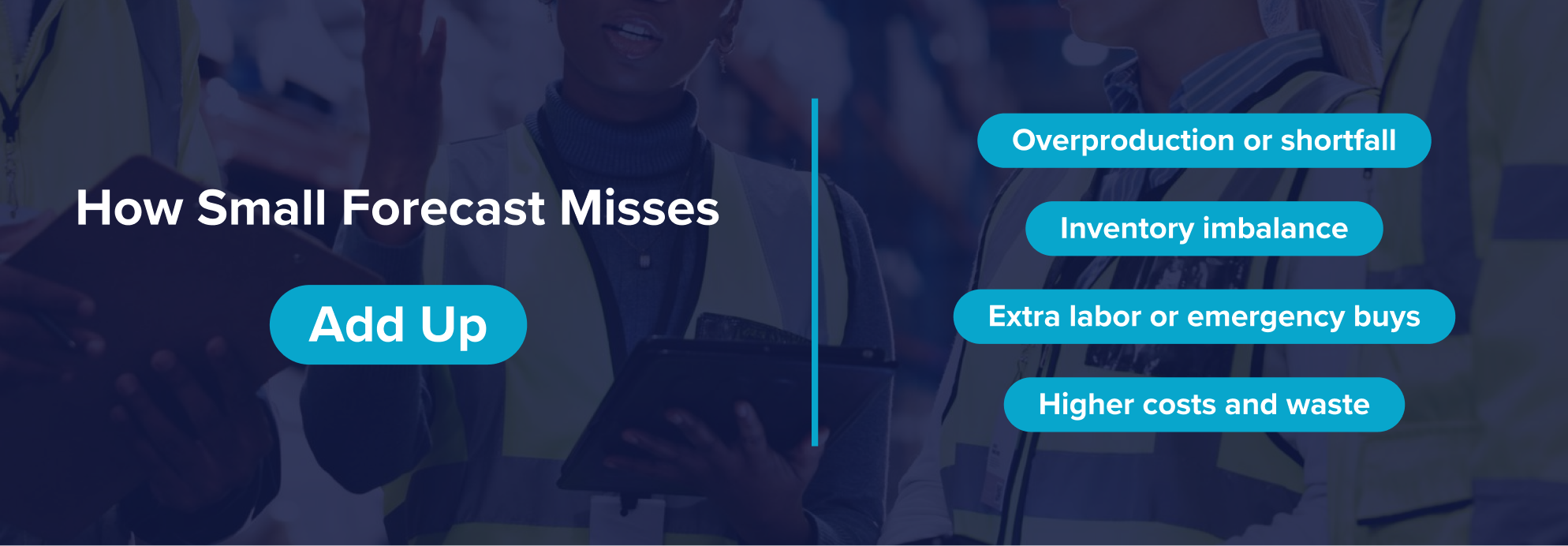
Earlier signals give planners more room to course-correct.
Intelligent Inventory Control to Reduce Overstock and Expiry Loss
Inventory rarely goes sideways overnight. It drifts.
A little extra stock here. Slower turns there. By the time expiration dates become the problem, the opportunity to fix it has already passed.
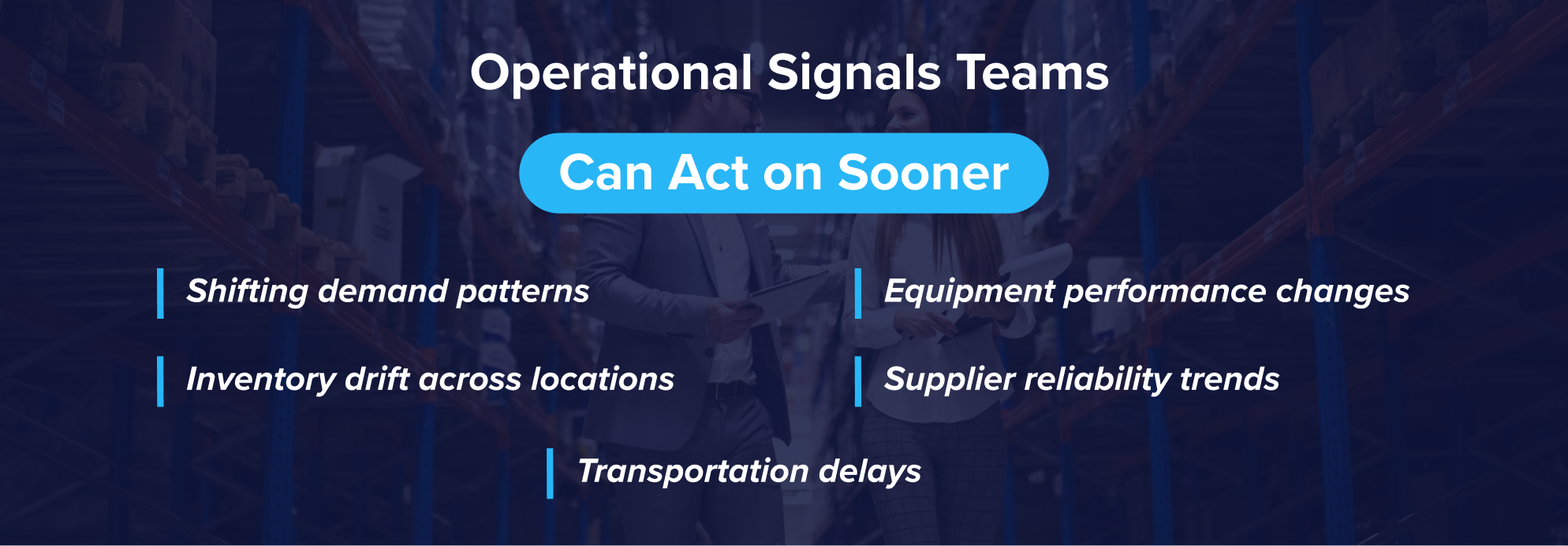
AI-driven inventory monitoring looks at how product is actually being used, not how it was expected to be used. When patterns start to slip, teams see it sooner and can act before inventory becomes a write-off or forces an emergency buy.
Route Optimization and Real-Time Shipment Tracking
Transportation plans look great on paper. The road usually has other ideas.
Delays, congestion, staffing gaps, and weather can all derail a schedule fast. The issue isn’t that disruptions happen — it’s how late teams find out.
With AI-supported routing and tracking, delays surface earlier. That gives teams options:
- adjust receiving schedules
- shift production timing
- activate backup plans
It turns surprises into manageable problems instead of fire drills.
AI-Driven Quality Control and Contamination Detection
Most quality issues don’t start with a single, obvious failure. They show up as small inconsistencies that are easy to miss when you’re reviewing data manually.
AI helps by scanning for patterns humans don’t have time to piece together:
- repeated temperature fluctuations
- handling variances across locations
- small deviations that keep reappearing
On their own, they’re noise. Together, they’re a warning.
Predictive Maintenance to Prevent Equipment Downtime
When equipment goes down, it’s rarely without warning. Output slows. Performance dips. Energy use changes.
Those signs are easy to overlook when maintenance is reactive. AI systems track those shifts over time and flag when something’s off, giving teams a chance to intervene before a breakdown forces production to stop.
In foodservice, downtime doesn’t just hit equipment budgets. It hits service and revenue.
AI-Powered Risk Identification and Disruption Prevention
Supply chain risk doesn’t live in one place. It builds when multiple weak spots line up.
AI pulls together signals across suppliers, transportation lanes, and demand trends to highlight where pressure is increasing. That might mean a supplier starting to miss targets or a route becoming unreliable.
Seeing those patterns early gives organizations more choices than simply reacting once disruption hits.
Automated Waste Monitoring and Surplus Redistribution
Waste is usually the final symptom, not the root cause.
When teams can trace waste back to where plans consistently miss — forecasting, production timing, inventory flow — fixes become more targeted and less disruptive.
In some cases, surplus is identified early enough to be redirected instead of discarded, preserving value that would otherwise disappear.
Core Advantages of AI in the Foodservice Supply Chain
The value of AI in the foodservice supply chain doesn’t come from flashy features. It shows up in quieter ways. Fewer surprises. Better timing. Less scrambling when plans change.
Over time, those small improvements stack up.
Improved Operational Efficiency
Efficiency in foodservice isn’t about doing more. It’s about doing fewer things the hard way.
When data is analyzed automatically and updated continuously, teams spend less time chasing reports or reconciling numbers across systems. That frees people up to focus on decisions that actually move operations forward, instead of reacting to yesterday’s issues.
It doesn’t eliminate work. It removes friction.
Cost Reduction
Cost control rarely comes from one big win. It comes from tightening the margins everywhere they tend to leak.
AI contributes by helping teams:
- avoid overproduction
- reduce emergency purchasing
- improve inventory turns
- limit waste caused by late decisions
None of those changes feel dramatic on their own. Together, they make a measurable difference.
Enhanced Food Safety and Compliance
Food safety programs depend on consistency, documentation, and follow-through. The challenge is maintaining all three at scale.
AI strengthens safety efforts by monitoring patterns across operations and flagging irregularities that might otherwise go unnoticed. It doesn’t replace audits or inspections, but it helps teams focus attention where it’s most needed instead of spreading resources thin.
Greater Visibility
Most supply chains already have the data they need. The problem is that it’s scattered.
AI brings information together across suppliers, locations, and logistics, creating a clearer picture of what’s happening right now and where pressure may be building. That visibility makes it easier to anticipate issues instead of discovering them after the fact.
Seeing the full picture changes how decisions get made.
Sustainable Supply Chain Practices
Sustainability in foodservice is often framed as a separate initiative. In reality, it’s closely tied to efficiency.
When forecasting improves and waste decreases, sustainability follows naturally. AI helps organizations use what they buy more effectively, reduce unnecessary loss, and make smarter use of resources without adding complexity to daily operations.
The result is a supply chain that’s not just leaner, but more resilient.
Implementation Challenges and Strategic Considerations
AI can deliver real value in the foodservice supply chain, but it’s not a plug-and-play solution. The organizations that see results are usually the ones that take a measured approach, focusing on fundamentals before expecting transformation.
Data Accuracy and Integration Issues
AI doesn’t fix messy data. It exposes it.
When information is incomplete, inconsistent, or spread across disconnected systems, results suffer. Forecasts skew. Alerts lose credibility. Teams stop trusting what they’re seeing.
Successful implementations start by cleaning up data flows and aligning systems, even when that work isn’t particularly exciting. It’s a necessary step, and skipping it almost always shows up later.
Technology Adoption and Infrastructure Costs
AI doesn’t have to be enterprise-wide on day one. In fact, it probably shouldn’t be.
The biggest mistake organizations make is trying to solve everything at once. The more effective approach is focusing on one or two areas where visibility is limited or decisions are especially costly, then expanding from there.
Investment matters, but so does scope. Clear goals tend to matter more than large budgets.
Managing AI Transparency and Decision Reliability
Trust is earned, not assumed.
Teams need to understand where insights are coming from and how recommendations are generated. When results feel like a black box, adoption stalls quickly.
AI works best as decision support, not decision authority. The strongest outcomes come when technology complements experience, rather than asking teams to ignore it.
Where This Leaves the Foodservice Supply Chain
AI isn’t changing the foodservice supply chain by rewriting the rules. It’s changing it by tightening the margins for error.
For years, supply chain teams have relied on experience, intuition, and hard-earned workarounds to manage complexity. That knowledge still matters. What AI adds is earlier visibility and better timing, especially in an environment where demand shifts faster and disruptions are no longer rare.
When used thoughtfully, AI helps organizations spend less time reacting and more time planning with confidence. Not because everything becomes predictable, but because fewer decisions are made in the dark.
FAQs
How does AI improve efficiency in the foodservice supply chain?
Efficiency improves when teams stop chasing information and start acting on it. AI reduces the manual effort required to analyze large volumes of operational data and surfaces issues earlier, giving teams more time to respond before problems escalate.
Can AI actually reduce food waste at scale?
Yes, but not by itself. Waste reduction comes from better alignment between forecasting, production, and inventory flow. AI supports that alignment by identifying where patterns consistently miss, allowing teams to make targeted adjustments instead of broad cuts.
Is AI realistic for small and mid-sized food suppliers?
It can be, especially when applied to specific challenges rather than full-scale transformation. Many organizations start with forecasting, inventory visibility, or logistics monitoring and expand only after seeing results.
How does AI support food quality and safety efforts?
AI strengthens existing safety programs by identifying patterns that are difficult to detect manually. It doesn’t replace inspections or audits, but it helps teams focus attention where risk may be building instead of relying solely on periodic reviews.
Is AI implementation always expensive?
Cost depends largely on scope. Organizations that start with clear objectives and a narrow focus tend to see returns sooner than those that attempt broad implementation all at once. The biggest investment is often not the technology itself, but the work required to prepare reliable data.